ReportOperationsAnnika Sorensen10 min read
ReportOperations


Power used to arrive as a regulated service: one counterparty, a published tariff, and a commission that had to approve the number. It now arrives as an architecture sold by the equipment vendor, with the generation booked through a turbine maker and the grid demoted to one of three options. Vertiv closed UtilityInnovation Group on 27 October 2026 and describes the result as “a single accountable relationship from grid interconnect through rack-level infrastructure”. That sentence is the product. The work of the next capacity contract is finding out what enforces it.
| Party and filing | Instrument and date | Size | What it now holds |
|---|---|---|---|
| Vertiv, Form 8-K Exhibit 99.1, filed 27 October 2026 | Completion of the UtilityInnovation Group acquisition, 27 October 2026 | About $1.45bn in upfront cash and up to $1.15bn contingent on 12 and 24 month EBITDA, at about 13 times expected 2027 EBITDA | Microgrid controls, onsite generation orchestration and behind-the-meter power architecture, from the grid interconnect to the rack |
| GE Vernova, Form 8-K Exhibit 99, filed 28 October 2026 | Quarter ended 30 September 2026 | 13 GW of slot reservations converted to orders, 11 GW of new gas contracts signed, 58 GW of reservations still held | The generation slot an onsite plant would be built on, sold at a Power segment EBITDA margin up 800 basis points |
| Portland General Electric, Form 10-Q filed 29 October 2026 and Form 8-K Exhibit 99.2 | Data Center Standard Service tariff, approved 7 July 2026 and effective 8 July 2026 | A 29.7 per cent average increase for data centre customers, and 473 MW under construction with five of them | The grid connected option, with capacity deposits, collateral, minimum demand requirements and exit fees |
Sources: Vertiv Form 8-K filed 27 October 2026, Exhibit 99.1; GE Vernova Form 8-K filed 28 October 2026, Exhibit 99; Portland General Electric Form 10-Q filed 29 October 2026 and Form 8-K filed 29 October 2026, Exhibit 99.2. Figures as each document states them.
Vertiv's release of 2 September 2026, announcing the agreement it closed eight weeks later, named what it would be able to support once UIG was inside: “grid-connected sites, bridge-to-grid deployments and islanded sites supplied by onsite generation”. That is the whole menu, published eight weeks after Oregon's commission approved a data centre tariff that raised that class 29.7 per cent while cutting residential, commercial and non-qualifying industrial rates. The completion release of 27 October 2026 put a price on the capability: approximately $1.45bn in upfront cash, and up to $1.15bn more if EBITDA targets over 12 and 24 month periods are met.
The multiple is the tell. At approximately $1.45bn the deal represents approximately 13 times expected UIG 2027 EBITDA, which is what a buyer pays when it expects the margin at the interconnect to last. Vertiv's September quarter, filed the day after the close, supports the reading: net sales of $4,313m, up 61 per cent with 55 per cent organic growth, an adjusted operating margin of 25.2 per cent, up 290 basis points, organic orders growth over 100 per cent, and full year guidance raised to $14,650m of net sales at 38 per cent organic growth.
As AI data center operators work to accelerate deployment in an increasingly power-constrained environment, access to power has become a critical competitive advantage.
The day before the close Vertiv completed a second purchase, King Environmental Services, a provider of “fluid management, commissioning and load-testing services for high-density, liquid-cooled data centers”. A vendor that owns the controls, the switchgear and the commissioning labour owns the weeks of the schedule that run before the first rack is installed. Vertiv's own account of the market is that “architecture decisions are moving earlier in the planning process”, which is the same sentence as saying the power decision is no longer made after the building is designed.
| Line | Opening position | Converted to orders | Newly signed | Shipped | 30 September 2026 |
|---|---|---|---|---|---|
| Equipment backlog | 53 | +13 | +3 | (5) | 64 |
| Slot reservation agreements | 63 | (13) | +8 | 0 | 58 |
| Total | 116 | 0 | +11 | (5) | 122 |
GE Vernova Form 8-K filed 28 October 2026, Exhibit 99: “Signed 11 gigawatts (GW) of new gas equipment contracts, including 8 GW of slot reservation agreements and 3 GW of orders. Converted 13 GW of existing slot reservation agreements to orders and shipped 5 GW of equipment; resulting in backlog growth from 53 to 64 GW and a decrease in slot reservation agreements from 63 to 58 GW.” The opening position is the release's own statement that the two categories “grew from 116 to 122 GW” in the quarter; its components, 53 and 63, sum to 116. Mosaic Singularity analysis, November 2026.
Read the two lines together and the queue is not draining. Thirteen gigawatts left the reservation book for firm orders and eight arrived to replace them in the same quarter, and the company expects the combined book to reach at least 130 GW by 31 December 2026. A tenant that needs onsite generation for a 2028 energisation is therefore not competing against a shortage that is clearing. It is competing against a book that refills as fast as it converts.
Oregon shows what is being displaced. The OPUC approved Advice 26-24 at a public meeting on 7 July 2026, effective 8 July 2026, creating a Data Center Standard Service tariff: an average 29.7 per cent increase for data centre customers against decreases of 1.3 per cent for residential, 2.1 per cent for commercial and 1.4 per cent for industrial customers who do not qualify. Oregon HB 3546, passed in June 2025, directs the commission to require electric companies to enter into a contract for services with large energy use data centre facilities on terms the law specifies. The contract is mandatory by statute, which is what makes the four protections bite.
Name the winner and the loser. Vertiv and GE Vernova win: one sells the architecture and the other sells the slot, and both expanded margin in the quarter to 30 September 2026. The regulated utility carries the exposure rather than a loss it has taken: the growth class it repriced in July, which PGE's own exhibit puts at about 12 per cent compound growth a year, now faces a product that does not need the rate at all, and a rate is the only lever a tariff has. The tenant wins speed to power and gives up what a regulated counterparty provides, which is a single party, a published price and a commission that can be appealed to. The tenant that signs is buying one relationship and will hold three contracts.
The completion release lists three customer benefits, and the third is the one that sounds like a transfer: “Accelerating access to power to ease or eliminate dependence on utility interconnection timelines”; “Enabling Behind the Meter (BTM) site capacity to scale beyond what the grid alone can provide”; and “Providing a single accountable relationship from grid interconnect through rack-level infrastructure”. None of them puts the generation on Vertiv's balance sheet. The release sells the opposite as a virtue, that the solution works “without tying them to a single generation technology or supplier”. The turbine is GE Vernova's contract. The gas is a third contract. The architecture is Vertiv's. A curtailment event or a generator that will not start lands on whichever of the three the contract says it lands on, and that is the clause being negotiated now.
No operator has yet disclosed an islanded or bridge-to-grid site in its own filings. The supply side has assembled and priced the option ahead of the demand that exercises it, which is why the clause matters more than the announcement: the vendor has committed to coordinate three sources of power, and has committed to own none of them.
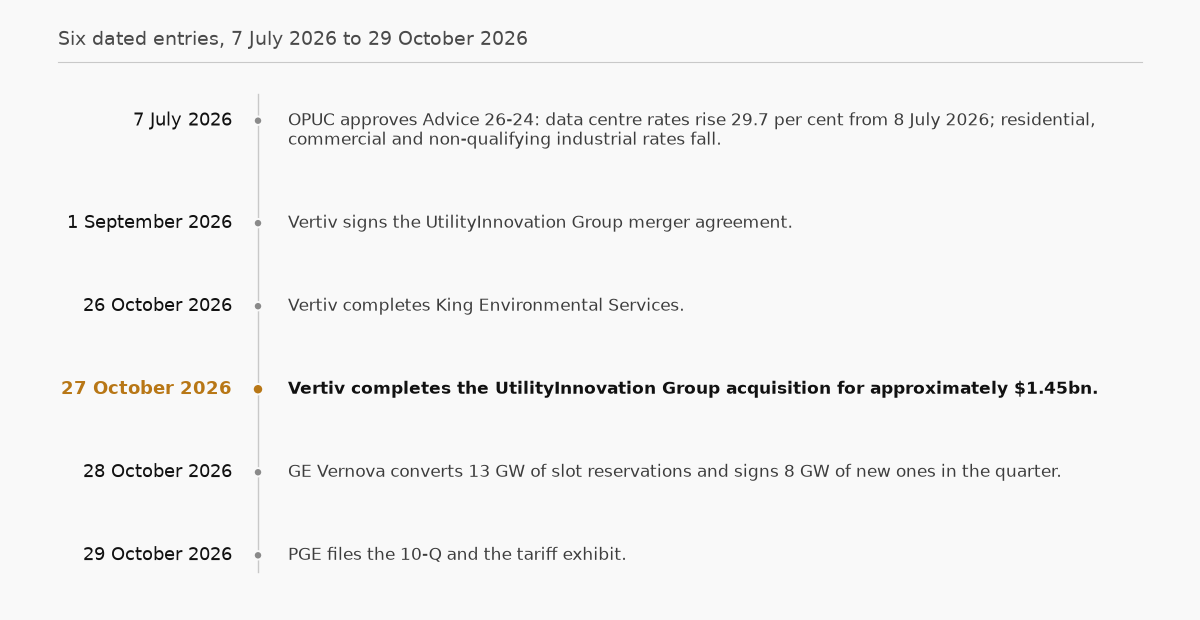
Three seats own three artefacts, and one signature produces all of them.
31 December 2026 is GE Vernova's own checkpoint: at least 130 GW of combined gas equipment backlog and slot reservations, from 122 GW at 30 September 2026. If it lands, generation is being booked forward faster than the sites that will burn the gas have been named. Vertiv guides $4,413m of net sales and 50 per cent organic growth for the quarter ending 31 December 2026, against organic orders growth over 100 per cent in the September quarter, so the question is whether that order rate was a step or a level. PGE says agreements with new large load customers “may be revised and updated” on the outcome of OPUC docket UM 2377, so the four protections are not final. For the chief executive the date is 31 March 2027: the capacity contract for any site that must energise in 2028, and the party it names to carry fuel, curtailment and generation uptime, go to the board for approval before signature and no later than that date.
If no capacity contract, 8-K or 10-K from a buyer discloses an islanded or bridge-to-grid site naming who carries fuel and generation uptime before 30 June 2027, this reading fails and the private plant stays a vendor's slide. The questions for the next board meeting are the ones the contract will answer: what carries the fuel if the bridge to grid lasts two years longer than planned, who pays if the interconnect lands after the racks do, and what the exit costs if the site is never built.
Share this
Related