ReportOperationsAnnika Sorensen9 min read
ReportOperations


The rent is not the exposure. The number of times the rent is set is. A 250 kW suite renewed at the category's average $317 per kilowatt a month costs $951,000 a year, and that rate is set again 18 months later; a tenant signing above 1 MW in the same nine months signed for 15.4 years. The decision belongs to the CIO and head of infrastructure, with the CFO on term and capex and the general counsel on the renewal clause, and the date that forces it is the 2027 budget, fixed before 31 December 2026.
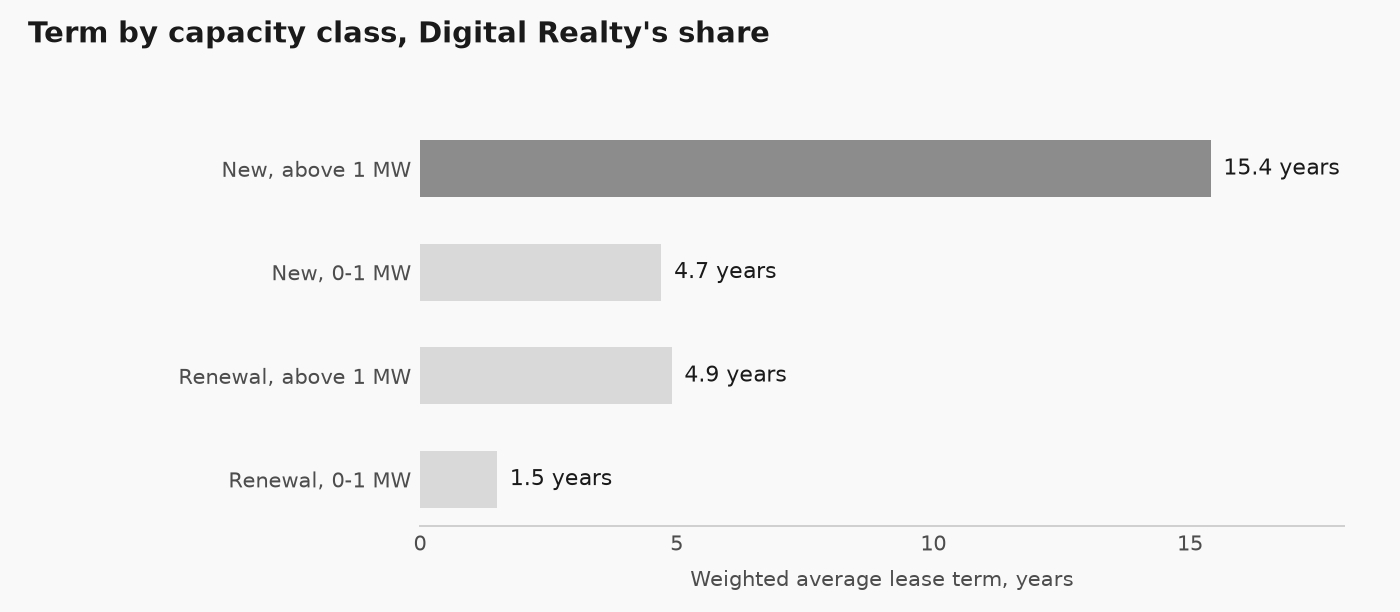
Digital Realty's leasing table for the nine months to 30 September 2026 separates the two categories twice. New leases in the 0-1 MW category covered 93,947 kW on a weighted average term of 4.7 years, at $263 GAAP rent per kilowatt a month. New leases above 1 MW covered 345,852 kW on 15.4 years, at $216. The larger category took 3.7 times the capacity on 3.3 times the term, and the 21.8% gap in rent per kilowatt is not a like-for-like price, because the table separates two different products. The term gap needs no such adjustment. It is the product. The table splits by megawatt, not by workload: the 15.4 years belongs to the class, and whichever tenant can sign above 1 MW buys it.
| Leasing category, nine months to 30 September 2026 | Capacity leased (kW) | Weighted average term | Rent per kilowatt a month | Change on renewal, cash (%) |
|---|---|---|---|---|
| New, 0-1 MW | 93,947 | 4.7 years | $263 GAAP | Does not apply |
| New, above 1 MW | 345,852 | 15.4 years | $216 GAAP | Does not apply |
| Renewal, 0-1 MW | 121,779 | 1.5 years | $300 expiring, $317 renewed | +5.7 |
| Renewal, above 1 MW | 100,467 | 4.9 years | $136 expiring, $209 renewed | +53.7 |
Digital Realty Form 10-Q for the quarter ended 30 September 2026, filed 30 October 2026, Leasing Activities table, DLR's share. The change on renewal is renewed cash rent per kilowatt divided by expiring cash rent per kilowatt, less one, computed from the four printed figures; Mosaic Singularity analysis, November 2026.
Read the renewal rows together and the headline changes character. Digital Realty's Form 8-K of 30 October 2026 reported rental rate increases on renewal leases of 11.8% on a cash basis in the third quarter, one blended figure for one quarter covering both categories. The nine-month leasing table separates them: the 0-1 MW category repriced 5.7% and the category above 1 MW repriced 53.7%. The tenant in the 0-1 MW suite did not escape repricing. It was repriced mildly, and it will be repriced far more often.
Renewing is a choice only where there is somewhere else to go. Digital Realty's Form 10-Q for the quarter ended 30 September 2026, filed 30 October 2026, reports 1,464 MW of projects under way, an increase of approximately 90% on 31 December 2025, with 63% of it, about 922 MW, pre-leased, and an estimated pre-tax stabilized cash yield of approximately 11.6% on that construction. Its Form 8-K of 30 October 2026 put the weighted average lag between new leases signed in the third quarter and contractual commencement at 17 months, so capacity committed in November 2026 serves a tenant about 17 months later, in 2028. What stands in front of the enterprise renewal is not a shortage forecast. It is signed paper.
Equinix's Form 8-K of 28 October 2026 reports the same two things: capacity arriving faster than it planned, and prices strengthening. Nearly 40% more cabinets are scheduled for delivery in 2026 than it initially anticipated, on expected total capital expenditure of $5bn to $6bn, and it raised full-year guidance for the third consecutive quarter. Record annualized gross bookings of $533m, up 35% year over year, came, in its own words, "on robust demand and strengthening pricing", alongside 6,900 net interconnections added in the quarter. Capacity is arriving. What a tenant needs to know is who it was built for.
Most of our revenue contracts have an initial term varying from one to five years, and thereafter automatically renew in one-year increments.
That sentence is the whole exposure. After that initial term, most Equinix revenue contracts become a one-year roll that continues until someone stops it. Interconnection is what makes the roll hold. Equinix added 6,900 net interconnections in the quarter and grew interconnection revenue 10% year over year, and more than 90% of its monthly recurring revenue bookings over the past three years came from existing customers. A tenant with its cross-connects through that building is not choosing between two landlords at renewal. It is choosing between a roll and a rebuild.
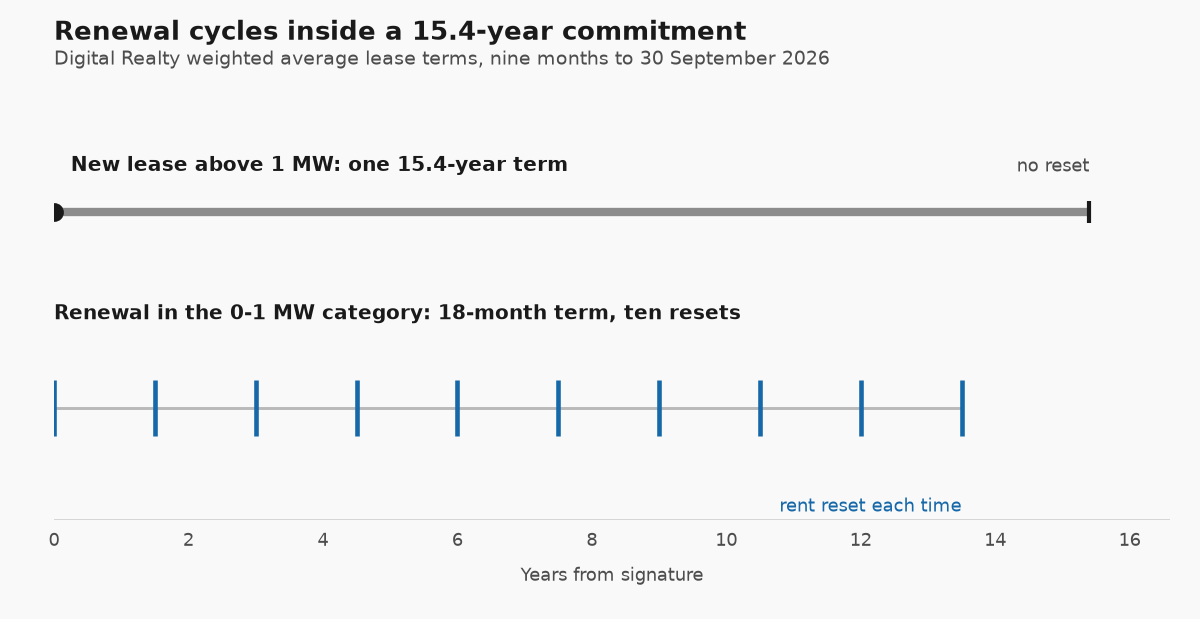
A small percentage applied often is the expensive case. Over the 15.4 years a new lease above 1 MW runs, a 1.5-year renewal resets about ten times, and the same 5.7% at each reset multiplies rent per kilowatt by 1.74. On a 250 kW suite the first step alone is $54,207 a year on top of $951,000. That is repeated arithmetic, not a forecast: it holds only while the landlord keeps taking the same step, and the sequence ends at the first renewal that takes none. The interval is what a forecast misses. A colocation line built on a flat annual escalator and a five-year assumption is wrong on the rate and wrong on the frequency, and an 18-month commitment is short enough to disappear from a lease maturity schedule that stops at the planning horizon.
Digital Realty's two largest customers accounted for approximately 11% and 10% of total revenue at 30 September 2026, and no other customer reached 10%. Those are the accounts a commercial team is organised around, and they are not the accounts that roll every 18 months. Equinix runs the opposite book: its largest customer was about 2% of recurring revenue and its 50 largest about 35%, which is why its renewal is a standard-form roll rather than a negotiation with a named team. The counter-case deserves its hearing. A landlord cannot sell 15 years on 40 kilowatts, and the 0-1 MW category is a mix of retail suites with no scale to commit; on that reading the term gap is a fact about size rather than a choice about power. It survives as an explanation and not as a remedy, because the tenant's exposure is the same either way, and the only lever size gives it is to consolidate.
By 30 November 2026 the board resolves the first question below, so that the count of agreements that renew automatically and the notice period that stops each one is tabled before the FY2027 budget closes on 31 December 2026.
Digital Realty's nine-month leasing table is the test, and the line to read is the weighted average term on 0-1 MW renewals. If the nine months to 30 September 2027 put that term at three years or longer, or the cash spread on that category at or below zero, the reading fails: the small tenant will have bought term at no toll, and the asymmetry will have been a property of supply rather than of the contract. Four other lines move the same way. The pre-leasing percentage as the 1,464 MW delivers, because a fall below half returns the tenant's alternative. The 0-1 MW share of bookings, which was $130m of $627m in the quarter, because a rising share means the landlord is competing for small tenants again. Any change to Equinix's stated initial term of one to five years. And the two-customer concentration in Digital Realty's next annual report, because a landlord protecting 21% of revenue prices the rest of the book to suit it.
Share this
Related