ReportOperationsAnnika Sorensen9 min read
ReportOperations



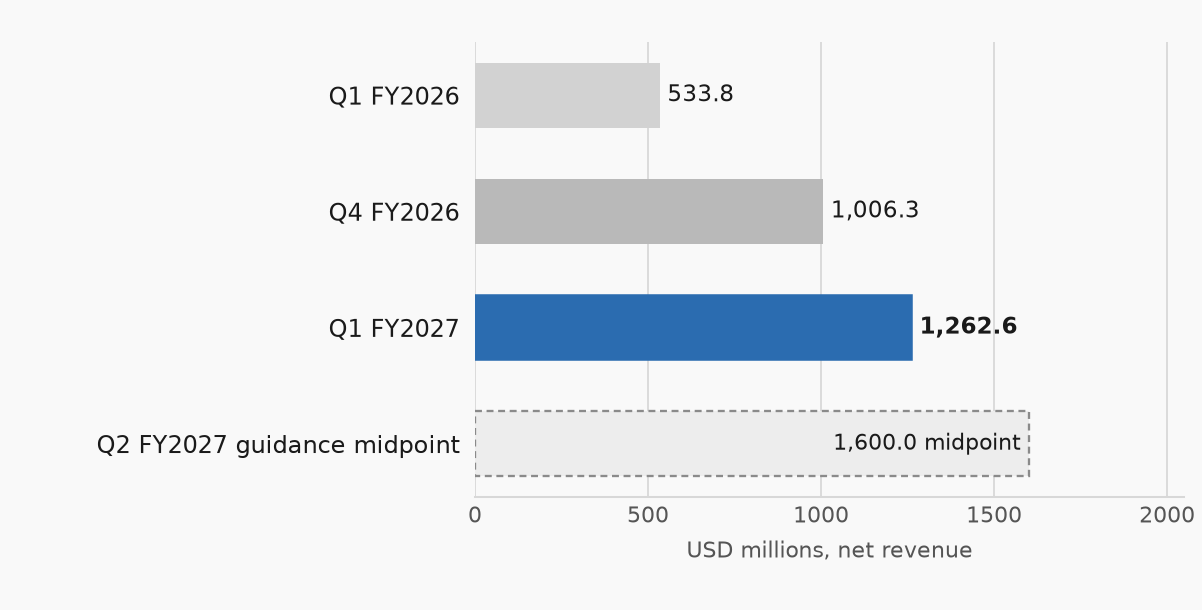
The optical link is where the AI build now sets its price. Lumentum's GAAP gross margin went from 34.0% to 51.0% in the year to 26 September 2026, on revenue that went from $533.8 million to $1,262.6 million, and the company guides the quarter ending 26 December 2026 to $1.575 billion to $1.625 billion. Marvell gave its reason in the joint release: “the physical limitations of copper-based connectivity are accelerating the transition toward optical technologies”. No filing says the link is scarce. The margin and the price say it.
The growth sits in the systems line, which is where the optical switching is. Components revenue was $754.2 million, up 98.9% year over year. Systems revenue was $508.4 million, up 228.8%. Non-GAAP gross margin was 53.2% against 39.4% a year earlier and non-GAAP operating margin 42.3% against 18.7%, so revenue multiplied by 2.4 and operating margin by 2.3 over the same twelve months. Margins that multiply with volume are what a seller earns when the buyer has nowhere else to go.
The commitment is the new instrument. In the release Hurlston describes the win as one “backed by purchase commitments exceeding $5 billion”. Against the September quarter's revenue that is about four quarters of the top line, committed ahead of delivery. The same release gives the amount and stops: it names no counterparty, no products, no quarters of delivery and no cancellation right. What the buyer has secured is not in the document that discloses it.
Eleven weeks before that disclosure, Lumentum described the opposite condition as a risk to its own shareholders. Its Form 10-K for the year ended 27 June 2026, filed 17 August 2026, says: “We rely on a limited number of customers for a significant portion of our sales; and the majority of our customers do not have contractual purchase commitments.” One quarter later the largest disclosed win is commitment-backed. The exposure did not disappear when the instrument changed. It moved to the buyer's side of the table, and the buyer is the party that cannot see the terms.
| Question | Form 10-K filed 17 August 2026 | Results release filed 2 November 2026 |
|---|---|---|
| Do buyers commit to volume? | For the majority, no: purchase orders and contracts “that do not contain volume or long-term purchase commitments” | One win “backed by purchase commitments exceeding $5 billion” |
| Who are the largest buyers? | Two customers at 30% and 11% of gross accounts receivable at 27 June 2026, against 13% and 11% a year earlier | Counterparty not named |
| What is the term? | Not stated for the majority of the book | Not disclosed in the release |
| What does the seller pay forward? | Two statements about suppliers: “advanced payments to secure orders from some of these suppliers” and “we have not entered into long-term agreements with many of these suppliers” | Not addressed |
| What margin does the seller earn on the link? | GAAP gross margin 34.0% in the quarter ended 26 September 2025 | GAAP gross margin 51.0% in the quarter ended 26 September 2026 |
Lumentum Form 10-K for the fiscal year ended 27 June 2026, filed 17 August 2026, Item 1A and Note 2; Lumentum Form 8-K, Exhibit 99.1, filed 2 November 2026.
The buyer's leverage is that concentration. Two customers were 30% and 11% of gross receivables at 27 June 2026, so the seller's book has become more dependent, not less, on the buyers who can commit, and a supplier in that position has little room to hold them to a shortage price. Fabrinet, an optical packaging and manufacturing contractor, reported revenue of $1,474.5 million for the quarter ended 25 September 2026, up 51% year over year, and guides the quarter ending 25 December 2026 to $1.6 billion to $1.65 billion. Capacity is being added at the stage that builds the modules, in the same quarter that the company holding the design agreed to be sold.
The agreement was signed on 1 November 2026, the day before the results. Marvell's Form 8-K sets the outside date at 11:59 pm Pacific time on 1 November 2027, extendable to 1 February 2028, 1 May 2028 and 1 August 2028 if regulatory approvals are not in hand, and prices the exit in three parts: $5.8 billion payable by Marvell if its board withdraws its recommendation or it terminates for a superior proposal, a reciprocal $2.9 billion from Lumentum, and a $3.2 billion regulatory fee payable by Marvell if the transaction fails on antitrust grounds or runs past the outside date once every other condition to closing is met. The $5.8 billion fee is about 5% of the implied enterprise value. The parties' own expected closing is the first half of calendar 2028, later than the outside date they began with, so their own timetable already runs past that first date.
That timetable is the buyer's problem. Co-packaged optics are chosen with the switch and the accelerator, not after them, so the specifications a buyer locks during 2027 will be served by a supplier whose owner is still inside a pending regulatory review. The exchange ratio is fixed at 4.500 Marvell shares per Lumentum share, so the currency of the deal is Marvell's share price rather than Lumentum's, and Lumentum holders end with about 33% of the combined company. The $550 billion addressable market and the more than $1 billion of run-rate cost synergies are the issuers' projections, not terms.
Lumentum's shareholders take a 23.9% premium to the unaffected close of 28 October 2026 and a third of a company that will own the electrical and the optical link. Marvell takes the part of the signal chain its own release says copper cannot carry, at 22.8 times Lumentum's September quarter revenue annualised, which is the price of not being the layer that gets designed out. The losers sit on both sides of that trade: the copper interconnect whose limits the release cites, and the buyer of modules who has committed money without a delivery date. The advantage lasts as long as capacity does not catch up. The design lock lasts longer, because once the optics are integrated into the package a second source is a re-design, not a purchase order.
On 31 January 2027 the board decides whether to approve the optical capacity commitment, on two documents: the commitment schedule the chief financial officer builds and the register of single-sourced optical designs the chief information officer returns, because the money is committed ahead of delivery and a second source is a re-design rather than a purchase order.
Three dates settle this. By 28 February 2027, when Lumentum reports the quarter ended 26 December 2026: if revenue lands inside $1.575 billion to $1.625 billion and non-GAAP operating margin comes in below 45.0%, the scarcity reading fails, because a supplier holding a shortage does not give margin back while volume arrives. On 1 November 2027, the outside date: if the transaction has not cleared and Marvell pays the $3.2 billion regulatory fee, the consolidation half fails and the buyer faces the same supplier, still unconsolidated. And at Fabrinet's quarter ending 25 December 2026, guided to $1.6 billion to $1.65 billion: if packaging revenue runs above that range while Lumentum's margin holds, capacity is arriving and still not clearing, which strengthens this reading rather than breaking it.
Share this
Related