ReportOperationsStrategic Intelligence Division11 min read
ReportOperations


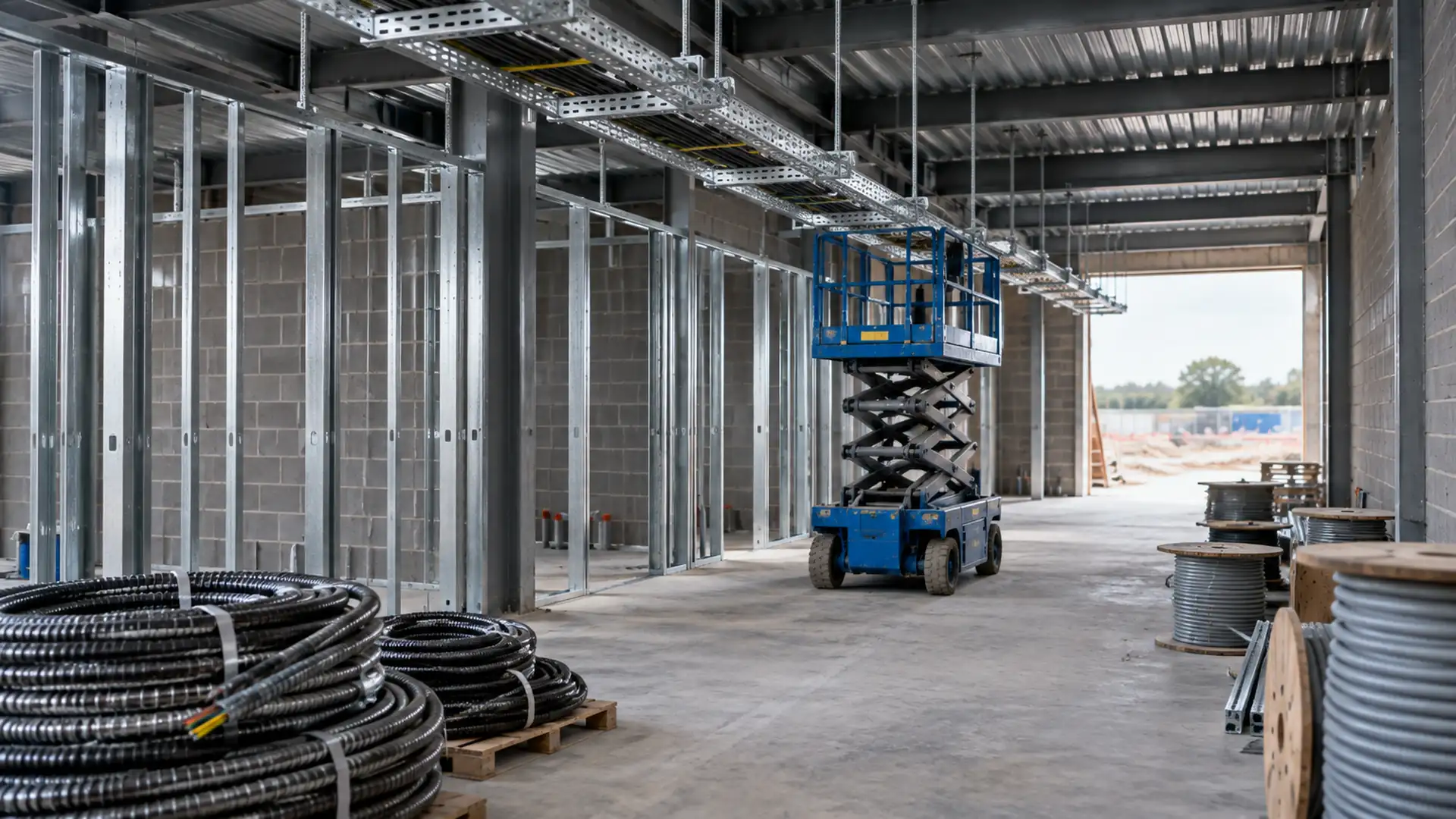
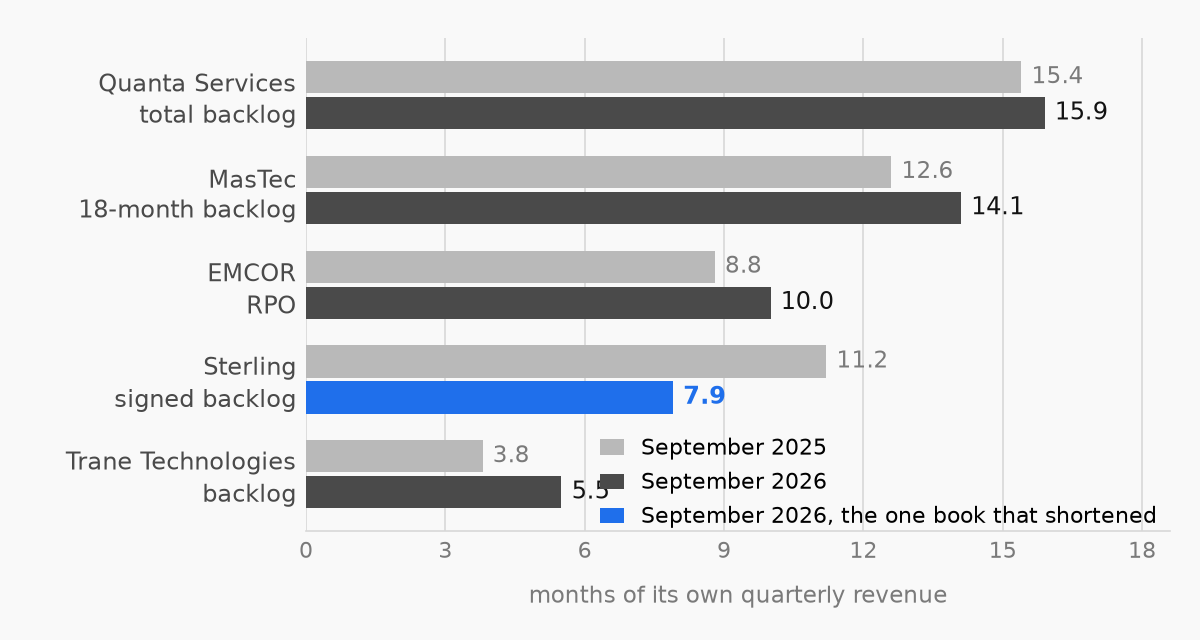
The 2028 delivery date on new AI capacity is a forecast about craft labour, and the crew that installs the plant appears in none of the filings that price it. Sterling Infrastructure's E-Infrastructure revenue rose 212% to $1.30 billion in the quarter ended 30 September 2026, and the company states that “Mission-critical projects, including data center campuses, manufacturing and semiconductor facilities, represent approximately 95% of this opportunity”, where the opportunity is the segment's signed backlog, unsigned awards and next phases in design, approaching $7 billion. Its signed backlog covers 7.9 months of its own revenue. A year earlier it covered 11.2.
This reaches you if you have leased or committed to capacity that must be delivered in 2028 and the installation is priced on a guaranteed maximum price or a fixed price. It reaches the developer signing the EPC for a hall already leased to a tenant, the CIO who wrote a 2028 date into an operating plan, and the CFO who will meet the escalation clause inside the construction budget.
| Company | Book as printed | What the book counts | Quarters of its own revenue covered |
|---|---|---|---|
| Sterling Infrastructure | Signed backlog $4.14 billion, up 61%. Combined backlog $6.14 billion, up 78% | Signed work only. The combined figure adds $2.00 billion of unsigned awards | 2.6, from 3.7 a year earlier |
| Quanta Services | Total backlog $63.73 billion, a record | $41.75 billion of remaining performance obligations plus $21.98 billion of estimated orders under MSAs | 5.3 |
| MasTec | 18-month backlog $24.5 billion, up $7.8 billion | Work scheduled inside an 18-month window, not a remaining performance obligation | 4.7 |
| EMCOR Group | Remaining performance obligations $18.57 billion, up 47.2% | Contracted revenue not yet recognised | 3.4 |
| Trane Technologies | Backlog $12.5 billion, up 73% | Equipment orders not yet shipped | 1.8 |
Each company's Form 8-K, Item 2.02, Exhibit 99.1: Sterling filed 28 October 2026, accession 0000874238-26-000122; Quanta 29 October 2026, 0001193125-26-436949; MasTec 29 October 2026, 0000015615-26-000127; EMCOR 29 October 2026, 0000105634-26-000132; Trane 29 October 2026, 0001466258-26-000001. Coverage is Mosaic Singularity analysis, November 2026: each printed book divided by the same company's revenue for the quarter ended 30 September 2026, at three months to the quarter.
Quanta Services prints a record $63.73 billion of total backlog, and $21.98 billion of it is a category Quanta calls “Estimated orders under MSAs and short-term, non-fixed price contracts”. What remains as a remaining performance obligation is $41.75 billion, 3.5 quarters of the $12.0 billion Quanta billed in the quarter. Of the whole book, $38.45 billion is scheduled inside twelve months, which is 3.2 quarters at the current rate. The contractor with the longest book in the set has less than a year of work inside a year.
MasTec's $24.5 billion is an 18-month backlog, and at $5.2 billion of quarterly revenue it fills 14.1 of those 18 months. EMCOR's $18.57 billion of remaining performance obligations covers 10.0 months, up from 8.8, and its largest growth came in a sector it names in its own words: “The most significant RPO growth occurred within the Network and Communications market sector as mission critical facilities continue to require substantial electrical infrastructure and increasingly sophisticated cooling systems.” Trane Technologies, which makes the chillers and the air handling, holds $12.5 billion of backlog worth 5.5 months of its $6.76 billion quarter, having booked $1.07 of orders for every dollar it billed.
Sterling is the only contractor in the set that names data centre campuses, and it is the only one whose book shortened: signed backlog of $4.14 billion covers 2.6 quarters of revenue, against 3.7 a year earlier, which is 7.9 months against 11.2. The combined figure that gets quoted, $6.14 billion, includes $2.00 billion of awards that are not signed. Sterling's book-to-burn for the quarter was 0.9x on signed backlog and 1.4x on the combined measure, 90 cents of new signed work for every dollar it billed. Revenue rose 127% and 70 points of that were organic; the rest came with acquisitions. CEC, the electrical business Sterling bought, quadrupled revenue on a pro forma basis, and the chief executive says the company now believes CEC “has the potential to generate over $1 billion in revenue in 2026”.
Set that book against the dates the filings publish. TeraWulf's filing of 4 November 2026 puts delivery of 401 MW to Anthropic “in phases beginning in late 2027 and concluding in the second quarter of 2028”, with rent commencing on delivery of each data hall. Portland General Electric counts “Up to 420 MW of 2026 executed contract, not under construction, expected energization in 2028”. Delivery sits between late 2027 and 2028, against a signed book 7.9 months deep. Of the nearly $8 billion of scoped work Sterling names across the company, $4.14 billion is signed backlog and $2.00 billion is unsigned awards; the segment split is not disclosed. The work behind a 2028 date is not yet a signed contract in this market. It is a design pipeline and an assumption about who will be available to build it.
Four of the five describe labour as a resource they allocate, and not one of them says how much of it there is. MasTec's chief executive, Jose Mas, ties capacity to retention: “we believe retaining our experienced crews is critical to capitalize on the significant level of industry investment ahead”, in a quarter when “crews and equipment were underutilized” on delayed pipeline work. Quanta's Duke Austin calls his workforce fungible: “This flexibility allows us to strategically deploy resources where demand is strongest”. Sterling moved crews out of transportation, where revenue declined 3%, into E-Infrastructure. EMCOR lists “scarcity of skilled labor” among the conditions that could affect its results. A turbine is a purchase order with a delivery date and a chip is a wafer start. A crew is a hiring and training decision, and none of these documents carries one.
EMCOR's operating income was $545.8 million, 9.8% of revenues, against $405.7 million at 9.4% a year earlier, on a quarter that grew 28.8% with 25.5 points of it organic. Trane, one step upstream with the chillers and the air handling, went the other way: bookings up 21% and a GAAP operating margin of 19.9% against 20.3%, giving up in the same three months the 0.4 points EMCOR took. MasTec, which installs as well, went further down: operating income of $275 million on $5,152 million of revenue, against $250 million on $3,967 million, which is 5.3 cents of operating income on the dollar against 6.3 cents a year earlier, and its release puts the cause in “permitting related access delays on certain Pipeline projects”, where “crews and equipment were underutilized”. Its adjusted EBITDA of $486.4 million was still a record, and Sterling's more than doubled.
The unit to carry into your own budget is 9.8 cents. That is EMCOR's operating profit for every dollar of installation revenue in the quarter ended 30 September 2026, up from 9.4 cents, and it is the part of a construction budget that stays with the contractor whichever way the schedule goes. The buyer's counterweight is the contract form, and that is where the next decision sits.
Three documents decide who absorbs a delay. The construction contract chooses between a guaranteed maximum price, where the contractor carries the cost of its own labour and liquidated damages cap what the owner recovers, and cost-plus, where the owner carries it and the contractor's margin is a percentage of whatever the delay costs. The force majeure clause decides whether a shortage of trades is an excuse or a breach, and that is the clause a contractor has every reason to widen while labour is scarce. The lease decides the rest: at Hawesville rent commences on delivery of each data hall, so the landlord carries the revenue delay while the tenant carries the slip in its own compute plan against a price struck at signature.
The date belongs to the CIO, the price belongs to the CFO, and the sentence that decides which of them pays for a late crew belongs to the general counsel. That is the handoff this market is making: a capacity plan signed by one seat, priced by a second, enforced by a third, and delivered by a contractor whose crew count nobody in the chain has asked for.
| Seat | What to do | By when | Why that one |
|---|---|---|---|
| COO or head of delivery | Put the crew in the schedule: require the contractor to name the superintendent and the crew assigned to each phase, with the ramp by month, as a condition of award. | At signature, and in every case before 31 March 2027 | Sterling's signed book is 7.9 months deep, and of the nearly $8 billion of scoped work it names, $2.00 billion sits in unsigned awards. |
| CFO | Re-forecast the construction line at 9.8 cents of installer margin and model a two quarter slip at the liquidated damages cap before deciding whether the cap is worth its price. | Before 31 March 2027, when the 2027 to 2028 package is priced | EMCOR's operating margin rose to 9.8% from 9.4% in a quarter that grew 28.8%, and Trane's fell, so the margin is moving between the trades. |
| General Counsel | Read force majeure and delay relief for a labour shortage, and refuse a carve-out that turns the contractor's staffing risk into your schedule risk. | Before the EPC is signed, and before 31 March 2027 | MasTec's quarter shows how a labour and access delay is absorbed: permitting related access delays left crews and equipment underutilized and operating margin fell 96 basis points. |
| CIO or head of infrastructure | Decide whether to sign the 2028 commitment now or hold, and write the delivery date as a milestone with a consequence attached rather than a target. | By 31 March 2027 | TeraWulf phases delivery from late 2027 to the second quarter of 2028 and rent commences only on delivery of each hall. |
Mosaic Singularity analysis, November 2026, on the five filings of 28 and 29 October 2026 and the TeraWulf and Portland General Electric filings of 4 November and 29 October 2026.
The decision the board puts its name to is the 2027 to 2028 capacity and construction commitment, taken at the Q1 2027 board and in every case before 31 March 2027. What it approves is a package in which every 2028 delivery date carries the contract form that prices it, the signed backlog behind it, the liquidated damages cap, and a named superintendent for each phase. A date without those four is a target that has been written into a commitment. That is what the quarter makes urgent: four of the five contractors printed a longer book while the one that names data centres printed a shorter one, and none of them printed a crew count.
Share this
Related