ReportOperationsStrategic Intelligence Division10 min read
ReportOperations



ZoomInfo, filed 4 November 2026
Fair Isaac, filed 6 October 2026
Dropbox, filed 28 October 2026
HubSpot, filed 6 October 2026
The four issuers' own filings. ZoomInfo Form 10-Q for the quarter ended 30 September 2026, filed 4 November 2026, approximately 20% of headcount; Fair Isaac Form 8-K filed 6 October 2026, approximately 15% of positions; Dropbox Form 8-K filed 28 October 2026, approximately 9% of global workforce; HubSpot Form 8-K filed 6 October 2026, approximately 7% of workforce.
Four software vendors disclosed reductions of between 7% and 20% of their people in the 29 days to 4 November 2026, and two of them reported the cost of the removals outside the measure the market is shown. HubSpot's Form 8-K of 6 October 2026 carries both halves in one document: charges of approximately $65 million to $75 million that “will be excluded from the Company's applicable non-GAAP results and guidance”, and, in Item 2.02, “The Company remains confident in achieving its longer-term operating margin targets shared at its Analyst Day on September 17, 2026.” The charge is quarantined. The saving that follows the elimination of nearly 660 positions is not, and it lands in the margin the renewal is priced against.
The exclusion is a definition the supplier writes. HubSpot states in the same filing that the charges consist “primarily of future cash expenditures related to severance, notice period, employee transition and benefits payments”, that the role eliminations will be “substantially complete by the end of the first quarter of fiscal year 2027”, and that substantially all of the related cash is paid by 30 June 2027. What remains is described as “a flatter, faster organization”. A cost base that falls and stays down is a change to how the supplier trades; the charge is the price of making the change, recognised once and kept out of the figure the market is shown.
ZoomInfo shows what that does to a reported margin inside one quarter. Its Form 10-Q for the quarter ended 30 September 2026 reports income from operations of $23.6 million on revenue of $308.8 million, a GAAP operating margin of 8%, against adjusted operating income of $119.1 million and a non-GAAP margin of 39%. The 2026 Restructuring Program incurred $7.6 million of charges in that quarter. The line the company added back was $25.0 million of “restructuring and transaction-related expenses”, 3.3 times the charge its own note names and 8.1% of revenue. Revenue fell 2.9% against the prior-year quarter while the adjusted cost base, revenue less adjusted operating income, fell 5.3% (Mosaic Singularity analysis, November 2026). The nine-month GAAP figure of (58)% is a different fact and should not be read as the charge: it carries a $650.5 million goodwill impairment.
| Issuer and filing | Positions affected | Charge as stated | Reported treatment | AI in the operative text |
|---|---|---|---|---|
| Fair Isaac, Form 8-K filed 6 October 2026 | approximately 15% of positions | approximately $27.0 million pre-tax in the fourth quarter of fiscal 2026 | States the charge; the filing says nothing about a non-GAAP treatment | Yes, as one of four limbs: “integrating AI-driven product development” |
| HubSpot, Form 8-K filed 6 October 2026 | approximately 7% of the workforce; “nearly 660 HubSpotters” | approximately $65 million to $75 million | Excluded from non-GAAP results and guidance; longer-term margin targets reaffirmed in the same filing | Not in Item 2.05; the chief executive's letter in the same filing says the cut is “not driven by AI-related efficiencies” |
| Dropbox, Form 8-K filed 28 October 2026 | approximately 9% of the global workforce | approximately $27 million to $33 million of cash expenditure; $20 million to $25 million of incremental expense | States the cash and the expense; no non-GAAP treatment of the charge is stated in the filing | No, in Item 2.05 |
| ZoomInfo, Form 10-Q filed 4 November 2026 | approximately 600 employees, approximately 20% of headcount | $29.2 million incurred in the nine months to 30 September 2026 against approximately $33 million estimated | Excluded inside a $25.0 million line of restructuring and transaction-related expenses in the third quarter | No, in the restructuring note |
The four issuers' own filings: Fair Isaac Form 8-K filed 6 October 2026; HubSpot Form 8-K filed 6 October 2026, with the chief executive's letter furnished as Exhibit 99.1 to that filing; Dropbox Form 8-K filed 28 October 2026; ZoomInfo Form 10-Q for the quarter ended 30 September 2026, filed 4 November 2026.
Fair Isaac's Item 2.05 is the only operative text among the four that names AI, and it names it as the fourth of four limbs: the plan commits the company to “reducing the number of layers in the organization, simplifying the operating structure, optimizing processes and tools, and integrating AI-driven product development”. It then puts one charge against the whole plan: “aggregate pre-tax charges of approximately $27.0 million in the fourth quarter of fiscal 2026”, for “approximately 15% of positions”. No position count is stated, so the charge cannot become a cost per position, and the plan is expected to be “substantially completed by the end of the third quarter of fiscal 2027”.
HubSpot is the case that makes the disclosure unusable as evidence of substitution. Its Item 2.05 names no AI at all. The chief executive's letter to employees, furnished as Exhibit 99.1 to the same 8-K, addresses AI directly and rules it out: “This is not driven by AI-related efficiencies.” In the same letter the strategy is described as a shift “from building software that helps customers grow to delivering outcomes for them with AI”, and then: “That shift is transforming product, pricing and how we serve our customers.” A supplier that tells you AI is transforming its pricing and separately that AI is not why nearly 660 people left has given the buyer two sentences and no reconciliation between them.
Dropbox and ZoomInfo give the purpose and not the cause. Dropbox's Form 8-K of 28 October 2026 records “a reduction of its global workforce by approximately 9%” to align its investments with “top product and growth priorities”, with “total cash expenditures of approximately $27 million to $33 million” and “$20 million to $25 million of incremental expense”. ZoomInfo's 10-Q says its board approved the programme “in order to reduce operating costs and drive stronger operating leverage”, with the planned closure of its operations in Israel inside it. Three of the four therefore disclose a reduction and do not attribute it to AI, and one of those three says explicitly that AI is not the reason. A buyer auditing its supplier base cannot separate a substitution from a discipline exercise by reading the filing. The question that separates them has to be asked across the table.
Two issuers disclose a count and a charge, which is what turns a total into a unit. HubSpot's nearly 660 positions against $65 million to $75 million is roughly $98,000 to $114,000 a position. ZoomInfo's approximately 600 employees against an estimated total of approximately $33 million is about $55,000 a position. The gap is in what each charge covers rather than in what a job costs: HubSpot's is an estimate of severance, notice period, employee transition and benefits payments, while ZoomInfo's is “primarily of severance and employee benefits as well as other associated costs” and its excluded line also carries lease restructuring. Read within each issuer, the unit is the number to carry into a negotiation: a role whose loaded annual cost exceeds the charge has repaid its own removal inside a year, and from that point the saving recurs in the supplier's numbers rather than the buyer's.
The four timetables do not line up with each other. ZoomInfo expects its programme substantially complete by the end of 2026, and Dropbox expects to recognise substantially all of the incremental expense and pay a majority of the cash in the fourth quarter of 2026. HubSpot's roles are substantially eliminated by 31 March 2027 and substantially all of its cash is paid by 30 June 2027. Fair Isaac's plan runs to the end of the third quarter of fiscal 2027. At a renewal signed before 31 March 2027, two of the four have booked the charge and have not finished removing the cost, which is the window in which the buyer negotiates while the supplier is still paying.
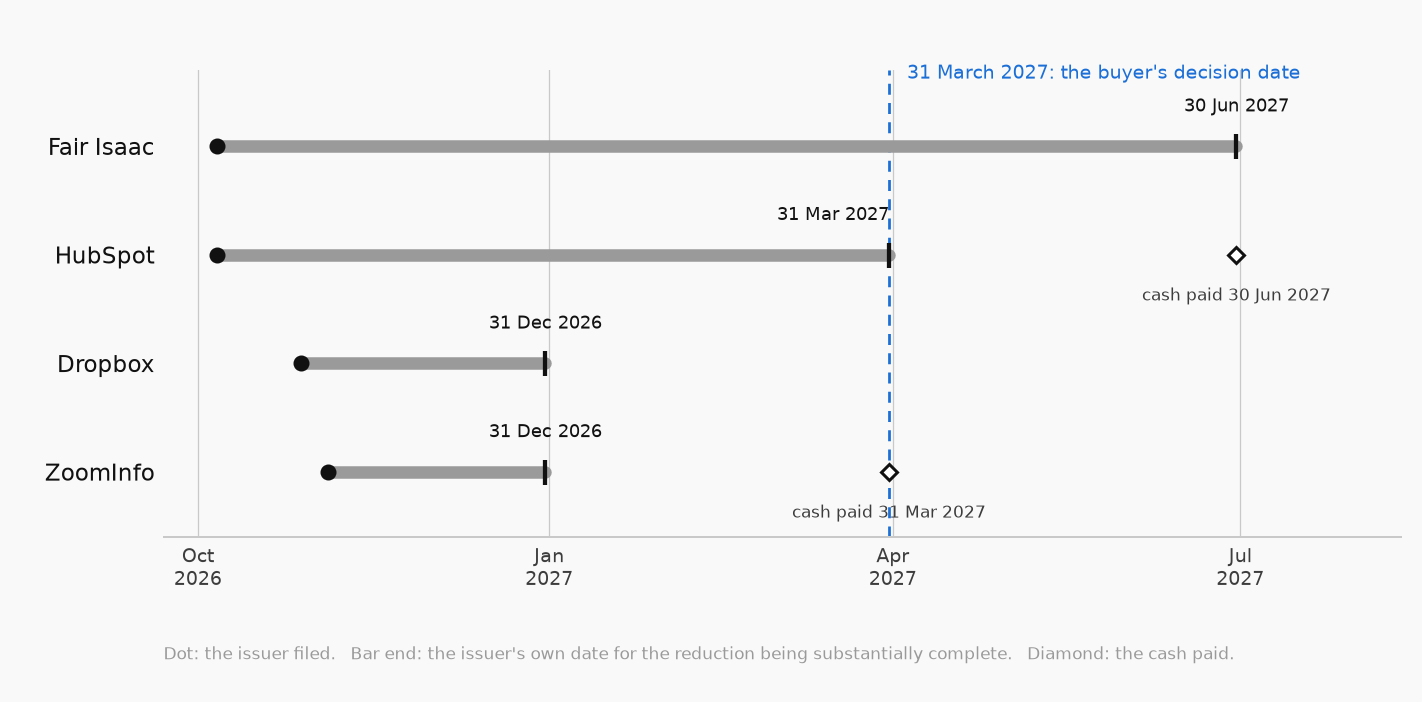
A multi-year licence signed in the FY27 cycle fixes a price against a cost base that is falling on the supplier's own timetable, and none of the restructuring disclosures states a change to price, so the fall is not yet in anything a buyer has been offered. The supplier's longer-term margin target was reaffirmed in the document that quarantined the charge. Three seats carry different parts of this: the chief procurement officer negotiates the commercial terms, the CFO signs the multi-year commitment and re-forecasts the line that pays for it, and the general counsel decides what the contract says the AI capability does, which is a different question from what the supplier says it does.
| Seat | What to do | By when | Why this one |
|---|---|---|---|
| CIO, with the chief procurement officer on the commercial terms | For every supplier that has filed Item 2.05 in the last four quarters, put the share of workforce removed and the charge into the renewal file, ask which functions went, and re-cut the discount ask against the charge the supplier has already booked | Before the FY27 renewal is signed, and no later than 31 March 2027 | HubSpot removed approximately 7% of its workforce at $65 million to $75 million and ZoomInfo approximately 20% at an estimated $33 million; that money is spent, and the list price does not reflect it |
| CFO | Require the supplier's most recent restructuring disclosure as a document in the multi-year approval pack, and re-forecast the FY27 software line on the basis that a supplier which removed 7% to 20% of its people has not passed the saving through | At FY27 budget approval, and before 31 March 2027 | HubSpot excluded the charge and reaffirmed its longer-term margin targets in the same filing, which places the saving with the supplier until a buyer negotiates it away |
| General Counsel | In any renewal that prices an AI capability, replace the supplier's claims about AI with a written description of what the system does, and make that description a contractual obligation | Before signature, on every FY27 renewal | ZoomInfo's own 10-Q records a putative class action alleging the defendants misstated “the growth of its AI-driven products”; a buyer that relied on a claim of that kind holds nothing it can enforce |
The four filings named above, and the dates the issuers themselves state: HubSpot's role eliminations substantially complete by the end of the first quarter of fiscal 2027 and its cash paid by 30 June 2027; ZoomInfo's programme substantially complete by the end of 2026. 31 March 2027 is the decision date set by this analysis.
The reading is that a permanent reduction in a supplier's cost base is being reported as a temporary charge, and that the buyer meets it as an unremarkable renewal. Two events would show the reading wrong, both of them visible in documents before 31 March 2027. If a supplier among the four cuts list price or improves support terms in a way a buyer can point to, the saving has passed through and the negotiation premise goes with it. If four more software issuers file Item 2.05 by that date and none excludes the charge from non-GAAP, the exclusion is these four issuers' choice rather than how the sector reports a reduction.
Share this
Related