ReportOperationsStrategic Intelligence Division10 min read
ReportOperations


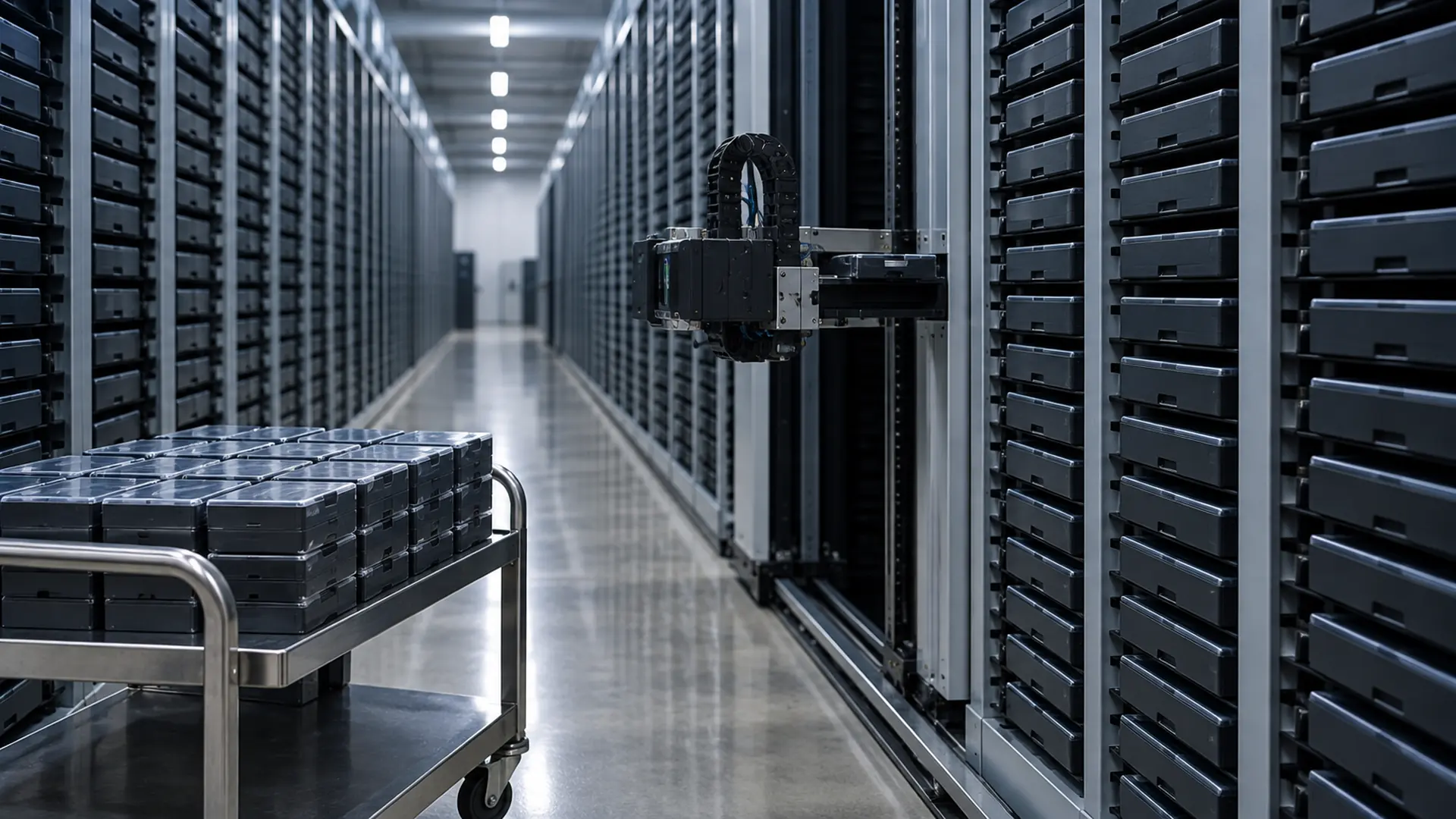
Sandisk's 10-Q for the quarter ended 2 October 2026 describes a storage contract that fixes what a customer must buy and only part of what it pays. The agreements, which the company calls New Business Models, “generally commit us to deliver, and our customers to purchase, a stated volume of products, mostly over multi-year periods”, and they carry “pricing mechanisms consisting of fixed and variable components”. Sandisk expects them to become “our predominant way of doing business”. The same note puts a number on what stands behind them: $12.8 billion of collateral issued or held at third-party financial institutions against $88.9 billion of remaining performance obligations, about 14 cents for every dollar of them. Sandisk recognises none of it, because it has no unconditional right to the money until a customer defaults.
This reaches the CIO who signs a multi-year storage commitment before the volumes arrive, the treasurer who finds the bank lines behind it, and the general counsel who reads the default clause. It reaches any owner of a retention schedule costed on the assumption that a terabyte gets cheaper every year.
Seagate shipped 220 exabytes in the quarter ended 2 October 2026 against 182 a year earlier, 20.9% more, and took 61.0% more revenue for them: $4,233 million against $2,629 million. Nearline drives, the tier that holds backups and archives rather than the working set, moved from 160 exabytes to 198 and are 90% of what the company ships. The filing gives the cause in its own words, “favorable pricing actions undertaken by the Company and an increase in nearline exabytes shipped”, and its chief executive gave it a name on 27 October 2026: “value-based pricing strategy”, held alongside “maintaining supply discipline”.
Quarter ended 3 October 2025
Quarter ended 3 July 2026
Quarter ended 2 October 2026
Seagate Technology Form 10-Q for the quarter ended 2 October 2026, accession 0001137789-26-000309. Revenue of $2,629 million, $3,629 million and $4,233 million divided by the 182, 218 and 220 exabytes shipped in the same three columns.
WD reported the same quarter a week earlier and guided higher: revenue of $4.38 billion, up 55% year on year, a GAAP gross margin of 57.8% against 43.5%, and revenue of $5.1 billion at a non-GAAP gross margin of 60.5% for the December quarter at the midpoint of its range. Its chief financial officer, Kris Sennesael, put “improved pricing” beside “robust exabyte growth” as the drivers. Sandisk's first fiscal quarter carried $11,031 million of revenue against $2,308 million and an 85.0% GAAP gross margin against 29.8%. Micron's fiscal 2026 revenue was $133.19 billion against $37.38 billion, at a gross margin of 80.7% against 39.8%.
| Company | Period reported | Gross margin | Same period a year earlier | Change |
|---|---|---|---|---|
| Seagate | Quarter ended 2 October 2026 | 57.3% | 39.4% | +17.9 points |
| WD | Quarter ended 2 October 2026 | 57.8% | 43.5% | +14.3 points |
| Sandisk | Quarter ended 2 October 2026 | 85.0% | 29.8% | +55.2 points |
| Micron | Fiscal 2026, twelve months | 80.7% | 39.8% | +40.9 points |
All figures GAAP. Seagate from its Form 8-K, Item 2.02, Exhibit 99.1, filed 27 October 2026 (0001137789-26-000300), and its Form 10-Q for the quarter ended 2 October 2026; WD, Sandisk and Micron from their Form 8-K, Item 2.02, Exhibit 99.1, filed 22 October 2026 (0001628280-26-066882), 29 October 2026 (0001628280-26-068243) and 30 September 2026 (0000723125-26-000018). Micron's is a twelve-month figure and the other three are the quarter ended 2 October 2026.
What the contract states is a volume. What it does not fix is the whole price for the term: the mechanism has a fixed and a variable component, so the part that floats keeps floating while the volume is already committed. Sandisk does not present that as a favour, and does not need to. The same paragraph says the agreements are “supported by financial guarantees that are intended to provide additional protection in the event a customer does not satisfy their contractual purchase obligations”, and that, “as NBMs are expected to become our predominant way of doing business”, the company believes the model will “contribute to greater predictability of revenue, support production planning, and enhance supply assurance for our customers”. Supply assurance is what the buyer is paying for; reduced cyclicality is what the supplier is buying.
Sandisk gives the aggregate: “The aggregate amount of collateral issued or held by third-party financial institutions was $12.8 billion as of October 2, 2026, representing the maximum potential proceeds available to the Company in the event of customer default or breach.” Against $88.9 billion of remaining performance obligations, of which $87.4 billion has not yet been billed, that is about 14 cents of standing collateral for each dollar of contracted volume. The company recognises none of it, because the right to the funds arises only on default or breach. What the buyer gives up in exchange is not only the option to buy later at the spot price: it is the use of the capital for the whole term. Refund liabilities, $1.6 billion against $1.5 billion a quarter earlier, “primarily include security deposits collected under NBMs that must be refunded at the end of the contract term”, so in that part of the book the cash is already with Sandisk, refundable to the customer after it has satisfied all performance conditions.
Seagate's chief executive put the two halves in one sentence on 27 October 2026: a HAMR-based roadmap “enables us to address growing exabyte demand through areal density gains while maintaining supply discipline”. Areal density is how a drive maker adds capacity without adding a factory, so the discipline is a decision rather than a constraint. That is what makes the position worth a 57.3% gross margin and what makes it fragile: the discipline is a decision each supplier makes separately, and the price holds only while they all keep making it.
The structure cuts the other way in a downturn, and the honest reading includes it. A buyer who fixed part of the price printed in that quarter has protection if the market falls, and a supplier that signed has given up part of the fall. Sandisk says so itself: the agreements “do not eliminate the risks associated with customer demand, market conditions, or operational execution”. What does not reverse with the price is the commitment. The volume does not shrink because the price turns out to be high, the deposit returns at the end of the term rather than the end of the need, and the bank line stays committed throughout. A buyer who is right about the price and wrong about the volume has still bought the term.
The unit to carry into your own plan is $4.80. That is how much more revenue per blended terabyte Seagate Technology took in the quarter ended 2 October 2026 than a year earlier, on its Form 10-Q: $19.24 million of revenue per exabyte shipped against $14.44 million, 33.2% higher, both Mosaic Singularity analysis, October 2026, on a blend that is 90% nearline by volume. A retention schedule is a cost decision taken once and renewed by default: how long the corpus is kept, how many copies, which tier holds the cold half. Every one of those defaults was priced when a terabyte got cheaper each year. Multiply the $4.80 by the terabytes in your estate, add about 14 cents of collateral for every dollar of volume you commit, and the archive tier stops being the cheap place to put a decision you have not made yet.
The question in front of a buyer is not whether storage is expensive. It is how much capacity to lock, for how long, at what proportion of fixed price, and with whose capital. Those answers belong to different people, and the collateral is arranged with a bank rather than the supplier, so it lives in a document the procurement file does not hold.
| Seat | What to do | By when | Why that one |
|---|---|---|---|
| CIO or CTO | Write the pricing mechanism into the commitment: which index the variable component follows, how often it resets, and a cap for the term. Where the supplier will not cap, shorten the term instead of enlarging the volume. | At the next commitment signed, and before 31 March 2027 | The volume is the part the contract fixes and the price is the part it does not. |
| CFO and treasurer | Size the collateral at about 14 cents for every dollar of committed volume and confirm the letters of credit or cash can stay committed for the whole term rather than renewed each year. | Before signature, because the deposit returns only at the end of the term | $12.8 billion of collateral stands behind Sandisk's book and none of it is on Sandisk's balance sheet. |
| General Counsel | Read the events of default that release the collateral, the conditions for returning the deposit, and whether the obligated entity is the parent or the operating company. | Before signature | Access is contingent on “specified events of default or breach” and the release waits for the end of the term. |
| COO or the owner of the retention schedule | Re-cost retention at $19.24 per blended terabyte instead of the deflating price the schedule was built on, and decide what stops being kept. | Before 31 March 2027 | The same tier costs 33.2% more per terabyte than a year earlier. |
Terms from Sandisk, Inc. Form 10-Q for the quarter ended 2 October 2026, accession 0001628280-26-068601. Price per terabyte from Seagate Technology Form 10-Q for the quarter ended 2 October 2026, accession 0001137789-26-000309.
Share this
Related