ReportGovernanceStrategic Intelligence Division11 min read
ReportGovernance



You cannot continuously authorize an identity you were never able to establish, and traditional identity providers break the moment an agent acts on its own.
The release that introduced the identity provider states no general availability date, and it carries a caveat worth holding beside every capability the platform claims: "Any unreleased services or features referenced here are still in development and subject to change. Customers should make their purchase decisions based upon features that are currently available." It introduced the runtime control and the identity provider on consecutive days in September 2026, then signed definitive agreements on 3 November 2026 to buy the company whose product attacks AI models before deployment and the company whose product traces what an agent decided. Both acquisitions are expected to close during CrowdStrike's fourth quarter of fiscal 2027, which ends on 31 January 2027, and both resulting products are slated to be generally available in that quarter. That leaves 87 days for any organisation whose endpoint renewal falls inside the window to decide whether an agent's identity stays with the directory its identity team already runs or becomes one more module on the security contract. It reaches you if your agents act through credentials the security platform already sees, or if your audit committee has started asking who can prove what an agent did.
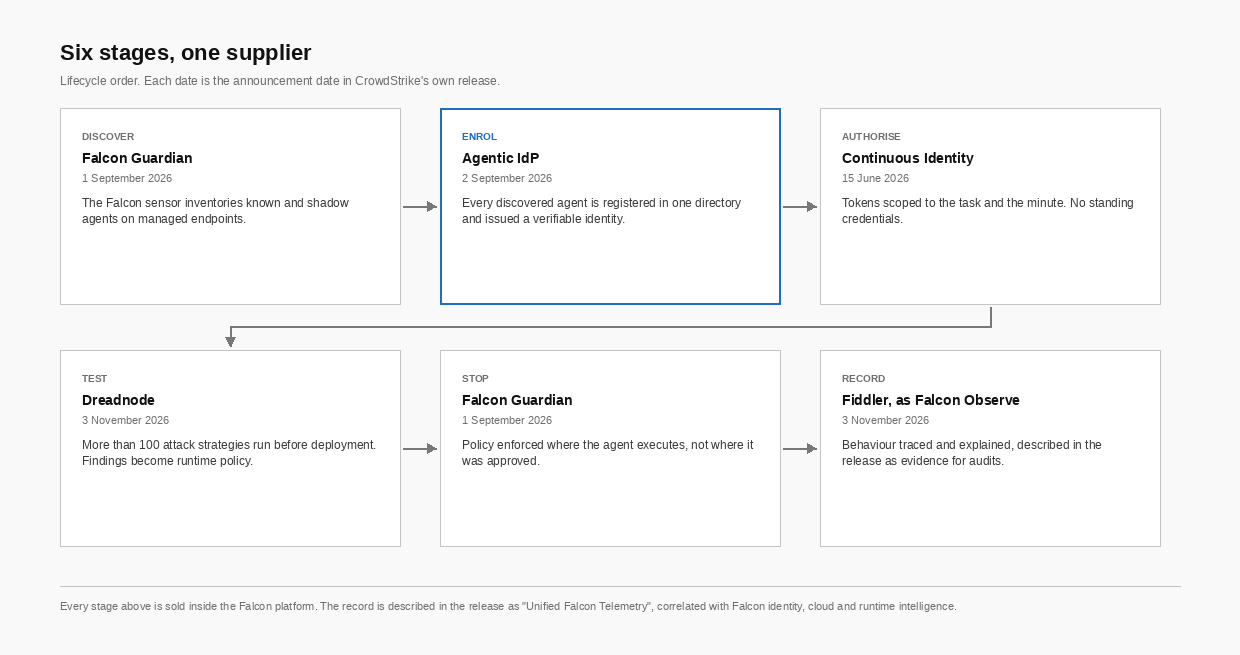
Falcon Guardian, introduced on 1 September 2026, is sold on the claim that the endpoint is where enforcement can actually happen: the release describes "complete visibility and runtime enforcement from the endpoint, where AI agents execute", and states that "Deployed across hundreds of millions of devices, CrowdStrike has more endpoint real estate than anyone. That structural advantage now defines AI agent security." Its first listed capability is an inventory: "The Falcon sensor discovers known and shadow AI agents across Windows and macOS, providing a live inventory of every running and dormant agent across the enterprise, who deployed it, and its security status."
The identity provider followed one day later, and it begins where the sensor stops. "Automatic Registration: Falcon Guardian discovers every AI agent across the enterprise, and Agentic IdP registers each one the moment it comes online under a single authoritative directory." Each agent is then issued "a cryptographically verifiable identity that cannot be spoofed or shared", and runs on "short-lived, tightly-scoped" tokens because "Agents are never given standing credentials of their own." An agent the sensor does not see is an agent the directory does not enrol: the releases describe discovery on the endpoint and registration on discovery, and neither describes enrolling an agent found by anything else.
Identity is the part CrowdStrike bought rather than partnered for. On 8 January 2026 it "signed a definitive agreement to acquire SGNL, a leader in Continuous Identity", to grant and revoke access "for human, non-human (NHI), and AI identities". The continuous authorization it announced on 15 June 2026 was, in its own words, "powered by technology from CrowdStrike's recent acquisition of SGNL", and assigns each agent an identity "based on the SPIFFE standard". In that architecture the credential is issued by the security platform, not by the directory the enterprise already operates, and the identity provider describes itself as "establishing Falcon Next-Gen Identity Security as the identity control plane for the agentic enterprise".
The model vendors are already inside it. The two companies announced on 2 September 2026 that the "New collaboration secures Codex agents with Falcon Guardian", with the security vendor controlling "Codex agent activity at runtime". OpenAI supplies the coding agent; the security platform decides whether it may act.
On the only price list CrowdStrike publishes, three bundles carry per-device monthly rates: Falcon Go at $7.99, Falcon Pro at $14.99 and Falcon Enterprise at $19.99. Identity is not one of them. "Even more add-on modules available, such as Next-Gen Identity Security and Next-Gen SIEM", the page says, and it publishes no rate for any add-on. So the arithmetic a buyer can do runs in one direction only: agent identity scales with the number of endpoints under contract, not with the number of agents running on them, and it arrives without a published rate that a competing bid could be held to.
CrowdStrike, Form 8-K filed 26 August 2026, accession 0001535527-26-000029, Exhibit 99.1, second quarter fiscal 2027 results: "Annual Recurring Revenue (ARR) grew 25% year-over-year to $5.84 billion as of July 31, 2026, of which $332.8 million was net new ARR added in the quarter"; the same release reports record net new ARR "accelerates growth to 51% year-over-year", more than "$2.29 billion in ending ARR from accounts that have adopted Falcon Flex" up 101%, and module adoption of 51%, 35% and 26% at six or more, seven or more and eight or more modules.
Module count is the number that explains the shopping list. On 31 July 2026, 51 per cent of CrowdStrike's subscription customers ran six or more modules, 35 per cent ran seven or more and 26 per cent ran eight or more, and $2.29bn of ending ARR sat in accounts on Falcon Flex, the consumption model that lets a customer swap modules annually. Runtime control, identity issuance, pre-deployment testing and the behavioural record arrive as attachments to a contract those customers have already signed, which is why the identity provider can be given away inside a platform that is priced per device.
Dreadnode is the half that runs before anything is deployed. The release of 3 November 2026 says its testing "runs more than 100 known AI attack strategies" against "the models, agent reasoning loops, applications, and MCP servers that power enterprise AI", maps findings to OWASP, MITRE ATLAS and NIST AI RMF, and closes the loop: "Dreadnode findings will feed Falcon Guardian as policy recommendations, so a weakness found in testing strengthens runtime protection." A flaw found in a test becomes a rule enforced at runtime, on the same platform, without leaving it.
| Capability | Announced | What it does | What you hold afterwards |
|---|---|---|---|
| Runtime control | 1 September 2026 | Finds agents on the endpoint, decides which may run, reconstructs the execution chain | An inventory and a policy, both inside Falcon |
| Identity issuance | 2 September 2026 | Registers each discovered agent in one directory, issues a verifiable identity, brokers short-lived tokens | A credential issued by the platform, not by your directory |
| Automated testing | 3 November 2026, generally available in Q4 FY27 | Runs more than 100 attack strategies before deployment and feeds the findings to runtime policy | Findings mapped to OWASP, MITRE ATLAS and NIST AI RMF |
| Behavioural record | 3 November 2026, generally available in Q4 FY27 | Traces decisions, reasoning paths and tool calls, described as evidence for audits | The record itself, correlated with "Falcon identity, cloud, and runtime intelligence" |
CrowdStrike releases of 1 September 2026 (Falcon Guardian), 2 September 2026 (Agentic Identity Provider), 3 November 2026 (Dreadnode) and 3 November 2026 (Fiddler). Rows three and four are the vendor's forward-looking statements: the Dreadnode release states that "Automated AI Security Testing will be generally available in Q4 FY27" and the Fiddler release that it "will be sold as part of the Falcon platform as Falcon Observe, generally available in Q4 FY27". Both acquisitions are expected to close in that quarter, subject to customary closing conditions.
Fiddler is the half that answers the question afterwards, and CrowdStrike has written down who is asking. "When a regulator or your board asks what an agent did, saying 'the model did it' is not an answer," said George Kurtz, chief executive. "Fiddler is the flight recorder for every agent: the observability to explain exactly what an agent did and why." The feature list under it is blunter still: "Auditable Governance: Track agent decisions and actions across first-party, third-party, and coding agents, providing evidence for compliance and audits."
Read those two paragraphs together and the exposure appears. The supplier that stopped the agent at runtime, and whose identity provider decided whether the agent could run at all, is the supplier of the evidence about what the agent did. The release does not describe the record leaving the platform; it files it under "Unified Falcon Telemetry: Correlate agent behavior with Falcon identity, cloud, and runtime intelligence", which is a description of where the correlation happens rather than of what the customer can take away. For a buyer, the difference between a record and a vendor feature is an export clause, a retention period and a named custodian, and the Fiddler release describes none of the three.
The counterweight is real and it is smaller than the platform. Sentra announced on 4 November 2026 that "Capital One Ventures has led a strategic capital investment of $150 million in the company", after what its release calls more than 300 per cent year-over-year growth. Its own statement of the problem is the clearest one anybody has published: "Each agent is a new identity, accessing data continuously and at machine speed, with no central control plane." What the release does not claim is the endpoint. Sentra puts its control on data at rest and on what reaches it, while enrolment in CrowdStrike's directory begins with an agent the sensor has already found, and that is the whole distance between a funded challenger and an installed base.
Share this
Related