ReportGovernanceStrategic Intelligence Division9 min read
ReportGovernance



Microsoft's Azure Retail Prices API, the vendor's own published price list for these SKUs, queried on 5 November 2026: Standard_D2s_v5 and Standard_D4s_v5, Linux, pay as you go, USD per hour, ten regions. Premiums and per vCPU figures are Mosaic Singularity analysis, November 2026: each region's rate divided by the East US rate, and 0.013 divided by two vCPUs.
Two EU member states, Germany and Poland, charge 0.115 US dollars an hour for the same virtual machine that Sweden charges 0.102 for, which is 0.65 cents a vCPU hour and 4.75 US dollars a vCPU a month at 730 hours. The buyer supplies the core count. The region that produces that difference is chosen before anyone knows the number, because a residency clause names a jurisdiction and the jurisdiction carries a price the clause does not mention. This reaches you if a member state is written into a residency attestation or a multi-year cloud commitment and the choice was made by whoever owns the obligation rather than whoever owns the compute budget.
| Region | EU member | USD per hour, 2 vCPU | Premium over East US | USD per vCPU hour | Rate in force since |
|---|---|---|---|---|---|
| East US | No | 0.096 | Reference | 0.048 | 1 November 2021 |
| Sweden Central | Yes | 0.102 | +6.25% | 0.051 | 1 January 2022 |
| Spain Central | Yes | 0.107 | +11.46% | 0.0535 | 1 February 2024 |
| UK South | No | 0.111 | +15.63% | 0.0555 | 1 November 2021 |
| Italy North | Yes | 0.112 | +16.67% | 0.056 | 1 December 2023 |
| Germany West Central | Yes | 0.115 | +19.79% | 0.0575 | 1 November 2021 |
| Poland Central | Yes | 0.115 | +19.79% | 0.0575 | 1 February 2025 |
| US Gov Virginia | No | 0.121 | +26.04% | 0.0605 | 1 November 2024 |
| US Gov Arizona | No | 0.121 | +26.04% | 0.0605 | 1 November 2024 |
| Norway East | No | 0.127 | +32.29% | 0.0635 | 1 May 2022 |
Microsoft's Azure Retail Prices API, the vendor's published price list, queried on 5 November 2026: serviceName Virtual Machines, Standard_D2s_v5, priceType Consumption, Windows meters excluded, unit of measure 1 Hour. The size is confirmed as 2 vCPU and 8 GiB on the vendor's Dsv5-series size page at learn.microsoft.com, read on 5 November 2026. Premiums and per vCPU figures are Mosaic Singularity analysis, November 2026. EU membership is not a vendor field.
Nine of the ten regions price the 4 vCPU machine at exactly double the 2 vCPU rate, which is what a per vCPU rate times a regional index looks like when the machine size changes and the region does not. East US charges 0.048 a vCPU hour, Sweden Central 0.051, Germany West Central 0.0575 and US Gov Virginia 0.0605, the same four figures as on the smaller machine. Norway East is the tenth and is not exact. Its 0.127 at 2 vCPU implies 0.254 at 4 vCPU, and the price list says 0.253; at 8 and 16 vCPU the per vCPU figure is 0.06325 both times, so the outlier is the 2 vCPU row and the 4 vCPU premium reads 31.77% rather than 32.29% (Mosaic Singularity analysis, November 2026). One row in ten moves, by a tenth of a cent an hour on the machine, on the highest rate in the table. The buyer's control set does not change between the two sizes: same region, same residency, same attestation, same agreement. What changes is the core count. The multiplier does not.
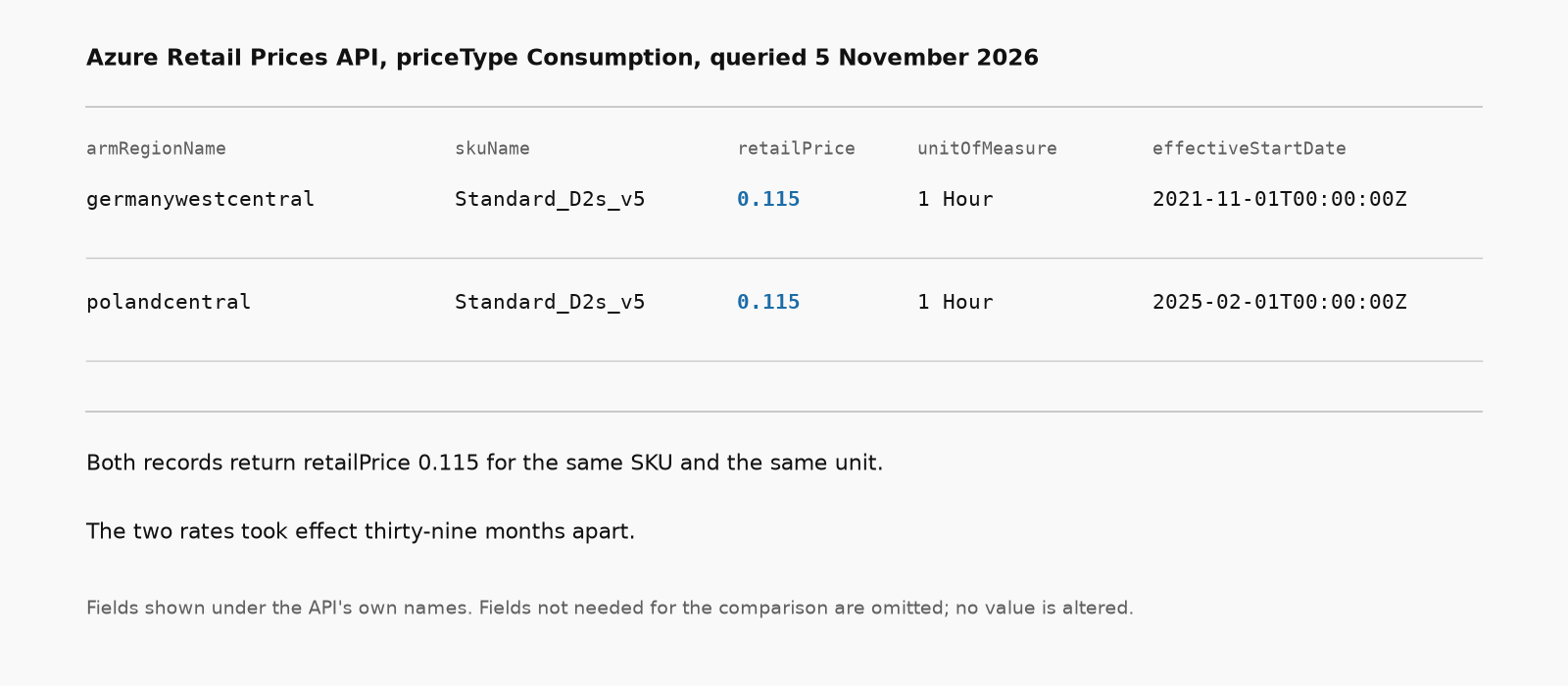
The sharper evidence is the pair at 19.79%. Germany West Central's rate has carried 0.115 since 1 November 2021, which is 1,830 days. Poland Central's has carried the identical 0.115 since 1 February 2025, thirty-nine months later, in a different country and off a different power market. A recovery of cost to serve does not land on the same three decimal places twice, thirty-nine months apart. A published band does, because a band is a decision and a cost is a measurement.
The multiplier does not track the number of controls a buyer accepts either. The two US Government regions sit at 26.04%, below Norway East at 32.29%, and the United Kingdom, which left the European Union in 2020, sits at 15.63%, above Sweden and Spain. An index that rose with regulatory burden would not produce that order.
A residency obligation is discharged by placing a workload in a named jurisdiction and attesting to it. The controls are the same in all five member states: one platform, one catalogue, one set of support terms, sold by one vendor under one agreement. What differs is the address. The vendor's published price list carries a rate per region per SKU and no field that describes itself as a regional premium, so the spread exists only once someone puts the regions side by side, and the party who would have done that is the party that chose the address on compliance grounds.
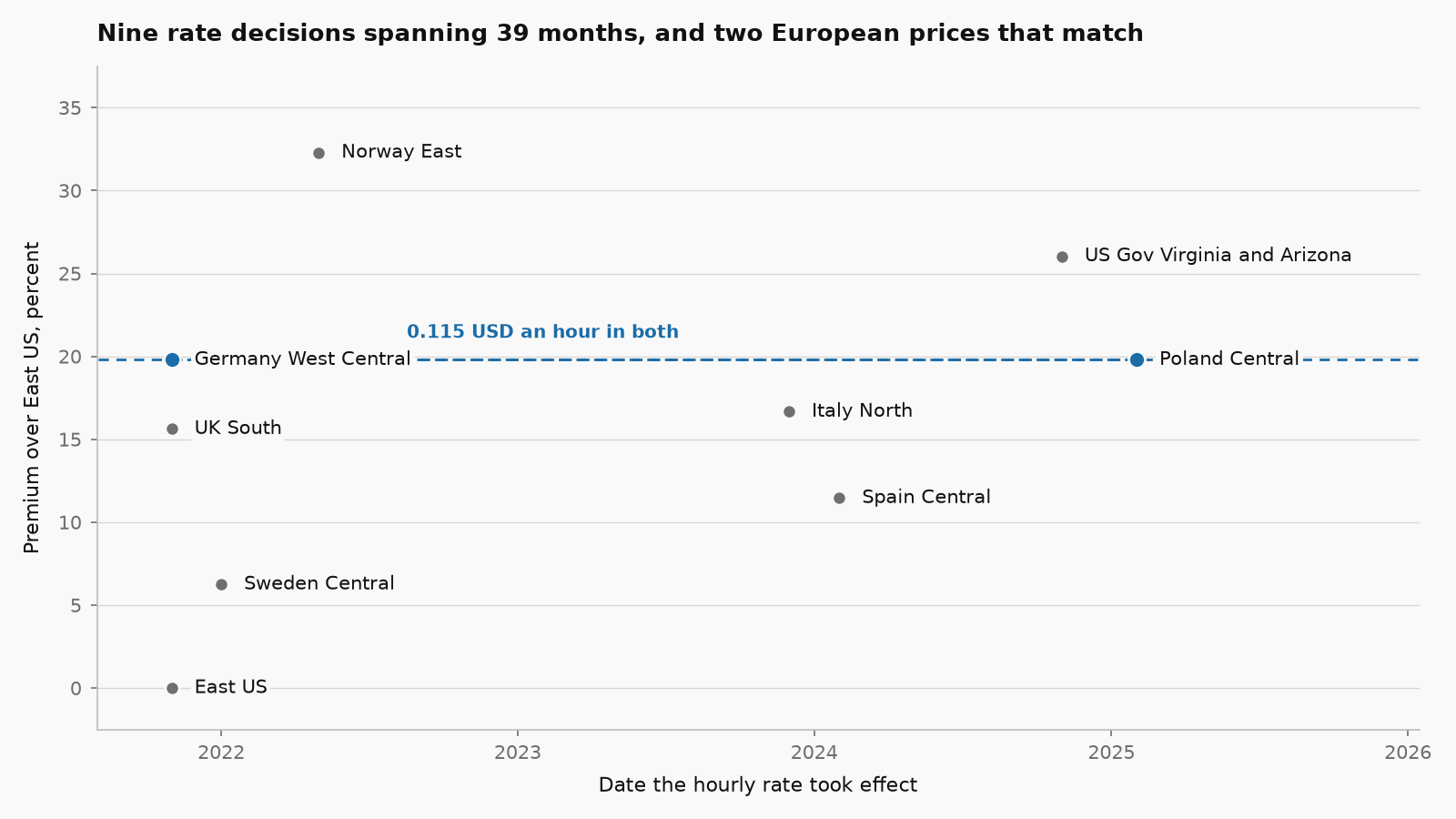
The obligation is satisfied in Sweden, Spain, Italy, Germany or Poland, five EU member states, at five prices between 6.25% and 19.79%. Written as the European Economic Area, the same clause admits Norway, the highest rate in the table at 32.29%. Written as Europe it admits the United Kingdom at 15.63%. One word decides whether the commitment sits at the bottom of the ladder or the top of it, and the person who chooses the word is usually the person attesting to the obligation, not the person signing the commitment value.
The exposure compounds, because the premium is a percentage on a per vCPU rate. Lift both regions by 10% and the percentage stays where it is while the Frankfurt to Stockholm gap rises from 0.013 to 0.0143 an hour (Mosaic Singularity analysis, November 2026). A buyer that treats the region choice as a one-off saving is buying a rate for the term, not a discount.
The buyer who reads the ladder takes the cheapest rung that satisfies the obligation, Sweden Central at 6.25% over East US, which is 0.3 cents a vCPU hour. The vendor is indifferent: the same machine, the same support, priced by country rather than by what it costs to serve that country. The enterprise that defaults to Germany because a customer's security questionnaire was easier to answer that way, or to Poland because a local entity already exists there, pays 12.75% more for the same outcome and holds an attestation proving it chose to.
Nothing on the invoice describes a regional premium. The line item is compute, the amount is larger, and the comparison that would have shown it is one that nobody in the process is paid to run.
| Seat | What to do | By when | Why this one |
|---|---|---|---|
| CIO or head of infrastructure | Re-query the price API for every SKU under a residency obligation on one date, and move each workload without a jurisdiction-specific requirement to the cheapest member state the attestation permits | 31 March 2027 | Germany and Poland charge 12.75% more than Sweden for the identical machine, 0.65 cents a vCPU hour, with no difference in the controls attached |
| DPO or CISO | Read the residency attestation before it is signed and confirm it names a member state rather than a boundary | At the next attestation, and no later than 31 March 2027 | Five member states meet the same obligation at prices between 6.25% and 19.79%, and the attestation is what makes the expensive one mandatory |
| CFO | Write the permitted region set and the multiplier into the cloud commitment before signature | 31 March 2027 | A clause that says EU permits any member state at the supplier's discretion, and the spread inside the EU is 6.25% to 19.79% |
| General Counsel | Check whether the residency clause reads EU, EEA or Europe | Before the next renewal signs, and no later than 31 March 2027 | Norway is in the EEA and not the EU and carries 32.29%, the highest rate in the table and 24.51% above Sweden |
Mosaic Singularity analysis, November 2026, on the Microsoft Azure Retail Prices API price list queried on 5 November 2026. The 24.51% is 0.127 divided by 0.102. 31 March 2027 is the close of the first planning quarter in which these rates and a signed cloud commitment can be put on the same page.
What reaches the board from this analysis is a single term: the permitted region set and the multiplier written into the cloud commitment before signature, by 31 March 2027.
Re-query Standard_D2s_v5 and Standard_D4s_v5 on 31 March 2027. If the premiums still read 6.25% and 19.79%, the reading holds that a buyer signs a fixed index and the region choice is the whole of the decision. If they have converged or crossed, the premium was a live price, and a buyer who signed in this window has a hedge to check rather than a saving to book.
The second test is the sovereign tier. Amazon's published AmazonEC2 region index, a price index whose stated publication date is 4 November 2026, carries 106 regions, of which exactly two are government regions, us-gov-west-1 and us-gov-east-1. No European sovereign region appears in it, so a buyer comparing a sovereign region against a standard one has no European sovereign rate to compare. The first such rate card will be the first priceable sovereign premium, and on the evidence of this ladder it will be published above the 19.79% ceiling. If it lands at or below 19.79% against that vendor's own standard European region, the claim that residency carries a vendor-set multiplier fails.
Share this
Related