ReportOwnershipStrategic Intelligence Division10 min read
ReportOwnership


| Company and filing | What it now says about inference | Revenue, period | Cost of revenue, same period | Gross margin, then and now |
|---|---|---|---|---|
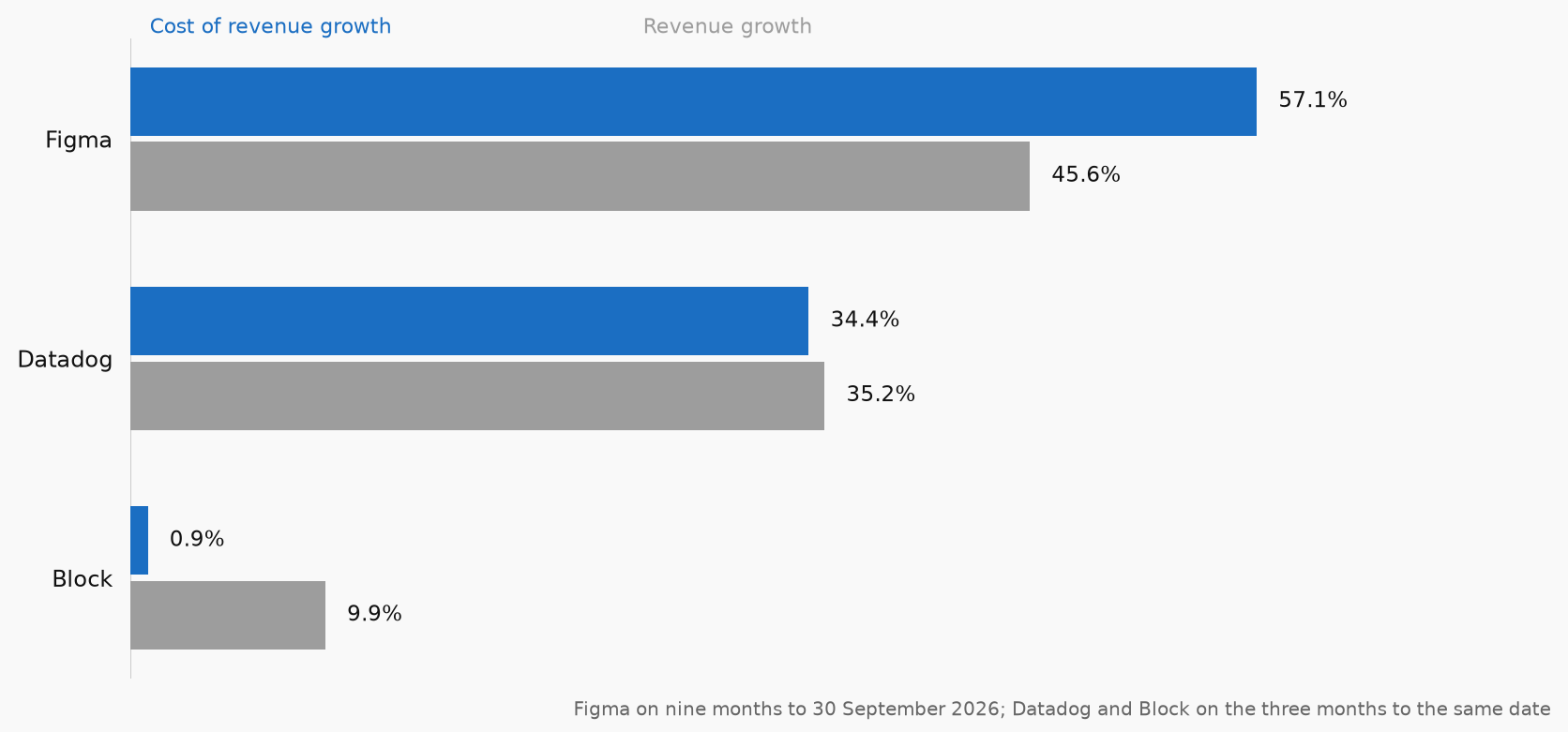
| Datadog, 8-K of 4 November 2026 | Scout, in Preview, "now powers Bits Investigation and achieves frontier-model performance at a fraction of the inference cost" | $1,197.1 million, up 35.2%, quarter | $237.2 million, up 34.4% | 80.19% against 80.08% |
| Figma, 10-Q filed 4 November 2026 | Cost of revenue "consists primarily of technical infrastructure and hosting costs, including AI inference", and AI spend is expected to "negatively impact our gross margins and operating margins" | $1,094.9 million, up 45.6%, nine months to 30 September 2026 | $206.1 million, up 57.1% | 81.18% against 82.55% |
| Block, 8-K of 3 November 2026 | "In October, we began rolling out model routing to all employees at Block" | $6,719.4 million, up 9.9%, quarter | $3,484.1 million, up 0.9% | 48.15% against 43.53% |
Printed columns of the three filings: Datadog, Inc. Form 8-K of 4 November 2026, Exhibit 99.1, accession 0001628280-26-069792; Block, Inc. Form 8-K of 3 November 2026, Exhibit 99.1, accession 0001628280-26-069513, both for the three months ended 30 September 2026; Figma, Inc. Form 10-Q for the quarterly period ended 30 September 2026, filed 4 November 2026, accession 0001628280-26-070272, on the nine-month columns, the period in which the company attributes a $90.3 million increase in AI-related hosting cost. Growth rates and gross margins are Mosaic Singularity analysis, November 2026: gross profit divided by revenue, each line divided by the same line a year earlier.
Three software companies told their investors inside 48 hours where the cost of running a model now sits, and the two answers that matter point opposite ways. Datadog put its own model behind a shipped product feature and grew revenue 35.2% while its cost of revenue grew 34.4%, leaving gross margin at 80.19%. Figma rents its inference, carries it inside cost of revenue, and printed a 137 basis point fall in gross margin over the nine months to 30 September 2026. This reaches you if you buy AI capability bundled into a per seat subscription rather than metered: the model is not on your invoice, so its price is not on your renewal, and the seller's cost of revenue note is the clearest public evidence of who is carrying it.
Datadog's exhibit reads as a product note and functions as a cost statement. Scout, in Preview, "now powers Bits Investigation and achieves frontier-model performance at a fraction of the inference cost", it says of the first specialized model from its own AI Research team. That phrase is the mechanism: a shipped feature, running on a model the vendor owns, at a fraction of what a frontier model costs to run. Datadog's revenue rose $311.4 million in the quarter and its cost of revenue rose $60.7 million, which is 19.5 cents of cost for every dollar of revenue added. Gross margin moved 11 basis points, from 80.08% to 80.19%, in the three months it introduced the model. The exhibit puts no number on the fraction and no date on which Scout leaves Preview, so the advantage holds for as long as that phrase does.
Figma's 10-Q puts the same cost on the other side of the line. Cost of revenue "consists primarily of technical infrastructure and hosting costs, including AI inference", and the filing tells investors that spend on AI inference and model training "will impact our cost of revenue, research and development expenses, and sales and marketing expenses, which we expect to negatively impact our gross margins and operating margins". The same filing names "changes in third-party model pricing" among the reasons its AI unit economics are hard to predict, which is the renter condition stated by the renter. The buyer reading a renewal sees a seat price. The vendor pricing that renewal is looking at a hosting bill that moves with use.
The nine-month columns are where a renter's economics show. Figma's revenue rose $342.9 million to $1,094.9 million and its cost of revenue rose $74.9 million to $206.1 million, 57.1% against 45.6%. The increase is put down to "a $90.3 million increase in technical infrastructure and hosting costs relating to AI and increased usage of our platform by paid users", partly offset by $27.6 million less in employee-related costs. Gross margin over the nine months to 30 September 2026 fell to 81.18% from 82.55%. On the company's own attribution, its added hosting cost is 26.3 cents for every dollar of revenue it added in the period.
The quarter on its own says the opposite, and that is the trap in reading one column. Cost of revenue fell 8% to $77.0 million while revenue rose 42.8%, so the three-month gross margin reads 80.33% against 69.40% a year earlier, which looks like expansion and is an artefact. Stock-based compensation inside cost of revenue fell to $3.6 million from $43.0 million over the same three months. Take it out of both periods and cost of revenue rose 79.5%, from $40.9 million to $73.4 million, and that margin fell to 81.24% from 85.08%.
Figma has been putting an AI allowance inside the seat price since 2025. "In 2025, we introduced AI credits across all Figma seats", the 10-Q says, and from March 2026 it "began enforcing AI credit limits and introduced flexible options for incremental usage", including add-ons to existing subscriptions and usage billed on a pay-as-you-go basis. That is a metered product sold inside a seat-priced one: an allowance included in the subscription, and a rate above it. A buyer negotiating a seat price in 2027 is negotiating the allowance, not the model.
Figma names its remedy and its constraint in the same part of the 10-Q. "If we are unable to increase prices to offset rising costs, including costs related to AI inference or otherwise related to providing AI features", its business, operating results and financial condition could be negatively impacted; and "contractual commitments or customer expectations may limit our ability to adjust included credits or pricing promptly". Read the second sentence as a buyer: where you hold a term, the vendor's margin carries the inference cost for the life of that term. Where you hold none, you carry it from the next renewal.
The number to carry into your own vendor review is cost of revenue added per dollar of revenue added, which is two printed lines in any 10-Q and one division. Figma 21.8 cents in the nine months to 30 September 2026, Datadog 19.5 cents in its quarter, Block 5.1 cents, and Block's figure is a mix effect rather than a model saving. A vendor adding cost slower than it adds revenue can absorb a model swap without repricing the seat. A vendor adding it faster has one route back to its old margin, and that route is the renewal.
Block is the third case and the one most likely to be misread, because it separates routing from ownership. It routed: "In October, we began rolling out model routing to all employees at Block, giving everyone access to a simple, efficient way to match their work to the right model capability". Employees, not customers, and an operating expense rather than cost of revenue. Product development expense fell 11% in the quarter, which the same letter attributes to "the organizational changes we executed in February". Its gross margin gain is a separate fact. Total cost of revenue rose 0.9% on revenue up 9.9% and gross margin went to 48.15% from 43.53%, but inside the total bitcoin ecosystem costs fell $165.3 million, from $1,917.3 million to $1,752.0 million, while commerce enablement costs rose $179.2 million. The margin came from a smaller bitcoin business, and nothing in the letter prices a model.
Routing is now a product in its own right, which changes who can see the cost without changing who owns the model. Nutanix's 10-K describes an agent gateway that provides "smart model routing, real-time cost visibility, and token-based rate limiting across both private and cloud-hosted LLMs". A buyer who installs that can see the token bill and argue with it. A buyer of a seat-priced product with an owned model inside it cannot, because there is no token bill in the commercial relationship and no line on the invoice to set against a benchmark.
| Seat | What to do | By when | Why that one |
|---|---|---|---|
| CIO or CPO | Require the order form to state whether inference for the AI features in scope is included in the seat price, what volume of use the price covers, and whether the model behind a paid feature may change without notice. | By 31 March 2027, and before any renewal signed in that window | Figma sells an AI allowance inside every seat and a metered rate above it, and it introduced AI credits across all seats in 2025. |
| CFO | Add one line to the 2027 vendor review: cost of revenue added per dollar of revenue added, from each vendor's last 10-Q. Figma 21.8 cents, Datadog 19.5. | By 31 January 2027, when the 2027 vendor budget is set | Figma's added hosting and infrastructure cost is 26.3 cents per dollar of revenue it added in the nine months to 30 September 2026, against a whole cost of revenue of 19.5 cents at Datadog. |
| General Counsel | Read the AI allowance and model-substitution terms in every AI-bearing subscription, and set the notice you require before the model behind a paid feature changes. | Before the renewal is signed, and by 31 March 2027 at the latest | Figma's 10-Q says contractual commitments and customer expectations may limit its ability to move credits or pricing promptly, so the term you hold is the hedge you have. |
| Audit committee chair | Ask management to list the five largest AI-bearing renewals, the date each current term ends, and whether each price covers AI use or meters it. | At the first board meeting of 2027, and before 31 March 2027 | Two of the three vendors moved an AI cost into cost of revenue inside one week, and one of them sells a metered rate above the allowance. |
Mosaic Singularity analysis, November 2026, on the three filings of 3 and 4 November 2026 and the Nutanix 10-K for the fiscal year ended 31 July 2026, accession 0001193125-26-394793.
Share this
Related