ReportOwnershipStrategic Intelligence Division12 min read
ReportOwnership


TeraWulf Inc. Form 8-K, 4 November 2026, Item 1.01; Form of Credit Support Agreement filed as its Exhibit 10.1, sections 2.k, 4.e and 12.b; TeraWulf press release, Exhibit 99.1, 4 November 2026.
Google agreed on 4 November 2026 to stand behind the rent on Anthropic’s 20-year, 401 megawatt lease at Hawesville, Kentucky, and the agreement that does it obliges the tenant to use only Google-approved tensor processing units in the building for the whole of its term. The credit and the silicon condition are one instrument, filed as a single exhibit. The agreement ends when Anthropic, a successor parent or a subsidiary holds investment grade for three months, so the guarantee and the lock it pays for lapse together. This reaches you if you are committing AI capacity years before delivery at a site whose landlord financed it against a chipmaker’s balance sheet, or if you buy capacity from a tenant who has.
Five parties signed: Raylan Data LLC as landlord, TeraWulf Inc. as landlord guarantor, Justified DataPower LLC as master landlord, Anthropic PBC as tenant, and Google LLC. The lease is a schedule to the credit support agreement, not the other way round. Section 2.k binds the tenant and any affiliate and then states that the obligation is the tenant’s alone and not the landlord’s, so the party that owns the building has no duty to police the hardware inside it and no right to permit an alternative. A team reading the lease for assignment rights, transfer rights and quiet enjoyment finds three data halls and nothing about chips.
TeraWulf puts the contracted lease commitments at approximately $19 billion. Across 401 MW over 20 years that is $2.37 million per megawatt-year, or about $197 per kilowatt of critical IT load per month, which is the number to hold against your own capacity contract (Mosaic Singularity analysis, November 2026). Against that, Google’s outlay is contingent and unfunded until something breaks. Nothing is payable unless the tenant defaults or becomes insolvent, and then the obligations run only from the commencement date of the last data hall, with delivery phased from late 2027 to the second quarter of 2028.
Section 2.j gives Google a consent right over any amendment that is not ministerial. Consent is not to be unreasonably withheld, with three exceptions where Google’s discretion is sole: an increase in the tenant’s payment obligations beyond a de minimis amount, an extension of the term, and a material increase in the tenant’s liability. Fifteen business days of silence on a request to amend is a rejection. Transfers by tenant or landlord need Google’s prior written consent, other than a Permitted Transfer, a carve-out the agreement invokes without defining. So the tenant cannot renew, extend or reprice its own lease without the agreement of the party supplying its chips, and cannot transfer the tenancy except as a Permitted Transfer or with that consent.
| Clause | What Google holds | What it does to the tenancy |
|---|---|---|
| 2.j | Consent to any non-ministerial amendment, with sole discretion on rent increases, term extensions and material liability; 15 business days of silence on a request to amend is a rejection | The tenant cannot renew, extend or reprice without the backstop’s agreement |
| 2.j | Consent to any transfer by tenant or landlord, other than a Permitted Transfer | A sale or assignment needs that consent unless it is a Permitted Transfer |
| 2.h, 2.i | Waivers by landlord and master landlord of every right to levy on, distrain or claim a lien over Google Property | Equipment owned by Google on the premises sits outside the landlord’s security |
| 3.a | A right, not an obligation, to cure a tenant default, with costs recoverable plus a 5% administrative fee | The provider can keep the lease alive, and is paid for doing it |
| 4.e | After paying a termination fee, the right to elect equity in the landlord equal to the fee divided by the cost to develop the site | A cash exit converts into ownership of the building |
| 12.b | Termination of the entire agreement once the tenant holds investment grade for three months | Every right above ends on that date, including the silicon clause |
Form of Credit Support Agreement, Exhibit 10.1 to TeraWulf Inc. Form 8-K, 4 November 2026, sections 2.e, 2.h, 2.i, 2.j, 3.a, 4.e and 12.b.
Section 4.d builds the termination fee from the lender’s figure rather than the tenant’s. The schedule is prepared on the anticipated amount of project debt and the projected sources and uses of funds, may be reduced to the actual debt once it is incurred, and is capped at the lesser of a stated dollar amount and a stated percentage of total uses of funds. The footnotes in the filed exhibit name the blanks for what they are: the anticipated maximum project debt amount, and the percentage of uses of funds permitted as project debt. Section 11 then caps Google’s total aggregate liability at that fee where it rejects the lease or is deemed to reject it. Set that against $19 billion of contracted rent and the gap is the landlord’s, which is why TeraWulf Inc. stands behind the landlord as Landlord Guarantor.
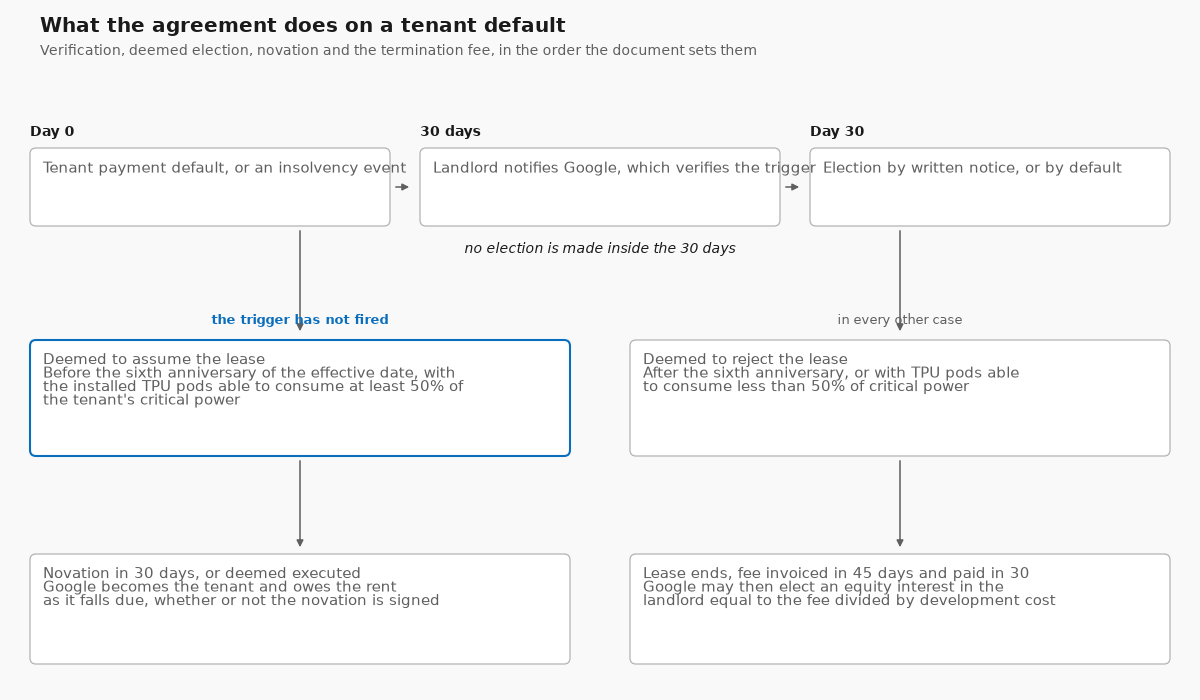
Section 4.c sets the default. If Google has neither elected nor deferred by the end of the 30-day verification period, it is deemed to have rejected the lease, unless that period ends before the sixth anniversary of the effective date and the equipment capacity trigger has not occurred, in which case it is deemed to have assumed it. The equipment capacity trigger is the point at which the TPU pods installed in the building, in operation, can consume less than 50% of the tenant’s critical power. That is the only place in the document where the silicon covenant has teeth. Inside the first six years, a site full of Google’s accelerators defaults to Google taking the tenancy and owing the rent. Outside them, and on a site that is not, silence defaults to Google walking and paying the fee.
Section 4.f makes the assumption hard to stop. The novation must be executed within 30 days of the election notice, and if it is not, the parties are deemed to have executed it when that period expires. Google is liable for rent as it falls due from the election, whether or not anything is signed. Section 2.g then allows up to 120 days of access to remove its own equipment, over which the landlord and master landlord have waived every right to levy or claim a lien.
NVIDIA’s residual value guaranties of 17 August 2026 are the same trade with the silicon left as a description. The tenant, an OpenAI affiliate, is recorded as using the capacity to deploy NVIDIA’s own platform, “subject to limited exceptions”; that is what the tenant will run, not what the credit turns on. NVIDIA pays the shortfall against a guaranteed minimum lease value when the tenant becomes insolvent or fails to pay, and the guaranty terminates early if OpenAI achieves a satisfactory credit rating. What Google’s document adds, set against it, is not that a chipmaker bought its customer’s rent. It is that Google wrote the accelerator into the credit agreement, defined a test that measures it, and attached a remedy to failing the test.
Fermi’s fact sheet of 14 October 2026 describes a binding 15-year phase one lease stated as “$6.5B over 15 Years” for 222 MW of total power capacity, of which 156 MW is critical IT, with credit support from AMD that begins once construction is complete and rent starts and ends early if the tenant or its guarantor holds an investment grade rating for 12 consecutive months. The same sheet describes the tenant as an AI cloud “built exclusively on AMD Instinct GPUs”. That is a description of a customer, not a covenant in a credit document, and it is not asserted here as one. Google’s agreement is the one that writes the requirement down and attaches a test to it.
| Instrument | Tenant and site | What the credit does | The silicon term | When it ends |
|---|---|---|---|---|
| Google Credit Support Agreements, 4 November 2026 | Anthropic, Hawesville, Kentucky, 401 MW over 20 years | Backstops the rent; Google may assume the lease or pay a termination fee | Section 2.k: only Google-approved TPUs, for the tenant and any affiliate | Investment grade held for three months |
| NVIDIA residual value guaranties, 17 August 2026 | OpenAI affiliate, Portsmouth, Ohio, about 4.25 GW | Pays the shortfall against a guaranteed minimum lease value on the tenant’s insolvency or payment failure | Stated deployment, not a condition: tenant “will utilize” capacity to deploy NVIDIA’s full-stack DSX platform, subject to limited exceptions | OpenAI achieving a satisfactory credit rating |
| AMD credit support, described 14 October 2026 | TensorWave, 222 MW over 15 years | Supports the project financing, beginning once construction is complete | None stated in the credit support; the tenant is described as built exclusively on AMD Instinct GPUs | Investment grade held for 12 consecutive months |
TeraWulf Inc. Form 8-K and Exhibit 10.1, 4 November 2026; NVIDIA Corporation Form 8-K, 17 August 2026; Fermi Inc. Form 8-K, Exhibit 99.1, 14 October 2026.
Together the three say what none of them says alone: the credit a chipmaker extends to a tenant’s landlord is a bridge across the tenant’s unrated period, and where the chipmaker wrote the condition down, it is paid for in silicon. Google gets 401 MW of accelerator demand that cannot be met by its rivals, consent rights over the lease’s economics, an option on the tenancy and an option on the building, for credit that costs nothing unless the tenant fails. Rival accelerator vendors are excluded from that site while it runs. A buyer of capacity there has lost the second source it thought it had and cannot see the clause that took it.
The advantage lasts as long as the tenant’s balance sheet is weaker than the landlord’s cost of capital, and on the face of the document it ends three months after Anthropic reaches investment grade. Two things run past that date. Re-qualifying a second accelerator across 401 MW of live capacity is an engineering programme measured in quarters, not a purchase order. And the defaults are not symmetric about the sixth anniversary. Before it, section 4.e bars Google from exercising the rejection option unless the pods installed in the building can, in operation, consume less than half the critical power, and section 4.c turns silence over the 30-day verification period into assumption of the tenancy, provided that period ends before the anniversary and the trigger has not occurred. After it, the same silence is rejection, and rejection is a termination fee sized to the project debt. Google holds the exit on a date the document sets. The tenant holds a 20-year lease it can neither reprice nor extend without Google’s consent. The loser is not Anthropic, which bought cheaper debt. It is the vendor that cannot bid for the site, and the customer that cannot ask for a second source.
| Seat | What to do | By when | Why this one |
|---|---|---|---|
| General counsel | Obtain the credit support agreement for any site behind a proposed capacity commitment, and schedule every consent right, deemed consent and novation clause | Before signature, and by 30 June 2027 for capacity arriving in 2028 | Section 2.k sits in that document, and 15 business days of silence is a refusal |
| CFO | Record the accelerator condition as a concentration and price the loss of a second source into the commitment | 30 June 2027 | Google’s liability stops at a fee sized to the project debt, so the backstop protects the lender rather than the rent |
| CIO or chief AI officer | Write to every AI capacity supplier asking whether the site is financed with vendor credit support and which accelerator the financing documents fix | 31 January 2027 | The covenant binds the tenant and any affiliate, and the tenancy can novate without a signature |
| Procurement | Insert a consent right over any novation of the tenancy, and a disclosure duty for any accelerator condition, into the capacity contract | Before signature, by 30 June 2027 | If the novation is not executed within 30 days, the parties are deemed to have executed it |
Dates are the division’s, set against the delivery schedule in TeraWulf Inc. Form 8-K of 4 November 2026, which phases delivery from late 2027 and concludes in the second quarter of 2028.
One decision does not stop below board level. The board approves the concentration schedule entry: every AI capacity commitment sited on a landlord financed with vendor credit support, the accelerator the financing documents fix, and the date that restriction lapses. The CFO presents it with the 2028 capacity plan, and it is approved before 30 June 2027, the date by which the capacity arriving in 2028 is committed. It belongs at that level because the entry records control as well as cost: the same document that fixes the accelerator also holds consent over the tenancy, the right to refuse an extension, and an option on the building.
One test decides it. If no second filing discloses a credit support agreement carrying an express accelerator condition before 30 June 2027, the reading that the rent guarantee is a procurement instrument fails, and this is one landlord’s financing rather than a structure. Before that date three things are visible: the amendments Raylan and Anthropic entered on 4 November 2026, disclosed under Item 8.01 and not filed; whether the first Hawesville hall is delivered on the schedule that starts rent in late 2027, since the backstop is not effective until the last one is; and whether Anthropic’s own filings name the covenant that binds it. If the site energises with accelerators Google has not approved and nothing follows under sections 2.k, 4.e or 12.b, the clause is decorative.
Share this
Related