ReportArchitectureAnnika Sorensen10 min read
ReportArchitecture


SK hynix Form 6-K filed 18 August 2026; Roku Form 8-K, Exhibit 99.1, filed 2 November 2026; HP Inc. Form 8-K, Exhibit 99.1, filed 26 August 2026
Memory content, not the feature list, now sets what a device costs and what it can be sold for, and the cost lands on whoever signs the purchase order. HP pushed 18 per cent more revenue through personal systems on 16 per cent fewer units in the quarter to 31 July 2026 at a 4.6 per cent operating margin. Roku's devices segment ran a negative 25.1 per cent gross margin on revenue up 33 per cent in the quarter to 30 September 2026. Above both, SK hynix reported a 76 per cent operating margin for the quarter to 30 June 2026. Two things are still under a buyer's control in the fourth quarter of 2026: the memory content written into the endpoint standard, and the price the 2027 refresh is budgeted at.
SK hynix reported revenue of Won 79.3 trillion for the quarter to 30 June 2026 against Won 22.2 trillion a year earlier, an increase of 256.8 per cent, and 50.9 per cent above the March quarter. Operating profit was Won 60.5 trillion, an operating margin of 76 per cent, which the company calls an all time quarterly record. DRAM average selling price rose in the mid-30 per cent range in the quarter. That is pricing power and it is shared: SK hynix held 29.1 per cent of the DRAM market in the quarter to 31 March 2026, so the price is a small group's decision rather than one supplier's.
SK hynix's 76 per cent is an operating margin taken after all operating costs. Roku's negative 25.1 per cent is a gross margin on one segment. They are not the same measure, the 101 point spread between them is not a transfer price, and subtracting one from the other proves nothing by itself. What they establish together is where the margin sat in the quarters to 30 June 2026 and 30 September 2026: upstream, with the company that makes the component, not with the companies that assemble and sell the device. Sources: SK hynix Form 6-K filed 18 August 2026; Roku Form 8-K, Exhibit 99.1, filed 2 November 2026.
Although adjustments to PC shipments and a partial slowdown in demand are expected in 2026 due to the purchasing burden resulting from recent memory price increases, the emergence of AI PCs is becoming a new growth driver for the market.
That is a supplier forecasting demand destruction from its own pricing, and it is the part of the report a buyer should read twice. It sits next to the part that does not reverse: "AI PCs require a minimum of 16GB of memory and, for high specification models, 32GB or more". A price can fall. A capacity floor stated as the requirement of the product category does not, and it lifts the memory content of every commercial seat in a refresh.
HP shows what that does to a P&L. Personal Systems revenue was $11.8 billion in the quarter to 31 July 2026, up 18 per cent, on total units down 16 per cent, consumer units down 19 per cent and commercial units down 14 per cent, at a 4.6 per cent operating margin. Eighteen per cent more revenue on 16 per cent fewer units is about 40 per cent more revenue per unit, and mix toward premium and commercial machines accounts for part of that, so the figure is not memory alone. The filing does not leave the cause to inference: "In Personal Systems, we face challenges with a competitive pricing environment, increasing commodity costs, particularly in memory and storage costs, and the uncertainty of the market's ability to absorb price increases."
The nine month note says the same thing forward: "we experienced higher inflationary pressure in memory and storage costs and supply constraints in our Personal Systems business, which we anticipate will continue." An OEM that sells 16 per cent fewer units and grows revenue 18 per cent is running price over volume, which holds only while buyers keep paying, and HP states its own uncertainty about whether they will. For a company buying those machines the arithmetic runs the same way: dearer units, fewer of them, and a refresh budget written before the repricing now buying less than it was set for.
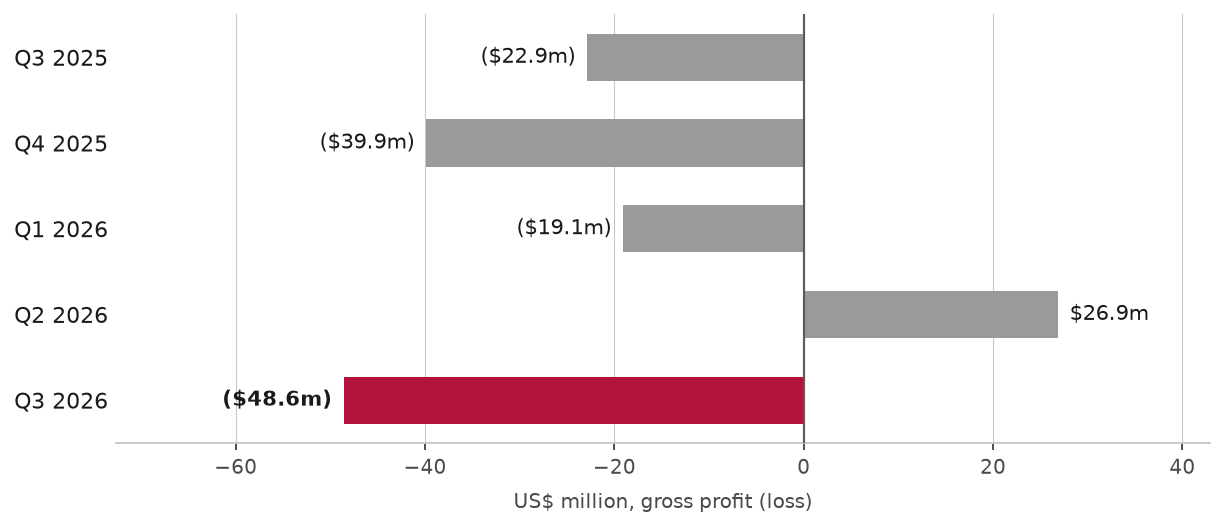
Roku's devices revenue rose 33 per cent to $193.7 million in the quarter to 30 September 2026 while devices cost of revenue rose 43 per cent to $242.3 million, a gross loss of $48.6 million against a gross profit of $26.9 million in the quarter to 30 June 2026. The cause is stated in the release: "with gross margin of (25.1%), driven primarily by elevated memory costs". The nine months to 30 September 2026 come to a $40.8 million devices gross loss. Read the whole company rather than the segment: total gross profit was $648.5 million at 43.2 per cent, up 24 per cent, and platform gross margin was 53.3 per cent. Devices are the shop window and the platform pays for them, which is why a memory price rise is survivable for Roku and is what breaks a maker that sells hardware and nothing behind it.
The cheapest memory is the memory a device does not need, and one platform is selling that to the brands it licenses. Roku again, in its own words: "The Roku TV OS requires significantly less DRAM and Flash than competing platforms, which lowers our partners' costs as memory prices continue to rise and is especially meaningful on smaller screens." That is a filed claim about somebody else's bill of materials, and a commercial move sits behind it: "TCL has expanded its Roku TV lineup at Target, and Hisense is moving its value assortment to Roku at Best Buy." Roku expects "these partnerships to contribute to Roku TV model unit volume in Q4 2026". Note what its devices revenue excludes: Roku TV models made and sold by its OEM licensing partners, "which account for the largest portion of our overall unit volume". The footprint argument earns Roku more in licensing than in its own hardware, which is why it is being made.
NETGEAR shows the procurement half and how little it buys on its own. Consumer segment gross margin was 27.3 per cent in the quarter to 28 June 2026, down from 29.4 per cent, and the segment swung from $3.3 million of contribution income to a $1.7 million contribution loss while company gross margin rose 270 basis points to 40.2 per cent on enterprise mix. Its remedies are the ones a buyer has: "we have secured sufficient memory supply for substantially all of our 2026 production plans for this segment" and it has "made significant progress in accessing supply directly from memory manufacturers", which is how an OEM stops paying a distributor for the privilege. It expects the enterprise impact "to remain nominal" on higher selling prices and "the benefit of our recent price increases", and the opposite for consumers: "rising memory costs to continue to adversely impact our business despite the mitigation efforts we have undertaken with our channel partners". It will "continue to prioritize gross profit over revenue in this segment", which is a decision to lose share rather than margin. Then the line a CFO should read twice: "The memory cost challenge is expanding to other parts of the Bill of Materials".
The board's move is one resolution, not a discussion: approve the endpoint standard that carries the 16GB per-seat floor and the 2027 refresh budget that prices it as a single item, by 31 December 2026, the date both are signed.
The test is simple enough to score. If DRAM average selling price comes in flat or falling quarter on quarter in SK hynix's third quarter report and Roku's devices gross margin returns above zero in the same window, memory was a price cycle and the margin goes back to the box. If the price holds while the 16GB floor enters the 2027 refresh, the compression reading stands, and the device maker keeps paying in units.
Share this
Related