ReportArchitectureStrategic Intelligence Division10 min read
ReportArchitecture


Arm has recently become a supplier of integrated circuit products, putting itself in direct competition with its licensees.
That sentence sits in the last paragraph of a risk factor about supply and capacity, and it is the licensee's, not the licensor's. On the same day Arm disclosed that it sells its own CPU direct: purchase orders secured from multiple customers extending through calendar 2027, first commercial deliveries on track for fiscal Q4'27, Oracle Cloud Infrastructure planning instances in 2027, and a target of up to $2 billion of Arm AGI CPU revenue across fiscal 2027 and 2028. Qualcomm reiterated a $5 billion data-centre target for fiscal 2027 inside the same 24 hours. This reaches you if you have written an architecture into a 2027 or 2028 server standard, or if you fund a data-centre silicon roadmap under a licence your company does not hold. The decision that follows is not which architecture. It is whether your second source is a named supplier holding a licence, or a word in a specification.
Arm's quarter to 30 September 2026 is what a licensor looks like when its platform is winning: revenue $1,443 million, up 27 per cent, licence and other revenue up 50 per cent to $773 million, royalty revenue up 8 per cent to $670 million, annualised contract value up 12 per cent to $1,790 million, non-GAAP operating income $638 million at a 44.2 per cent margin, and a non-GAAP gross margin of 97.9 per cent. The royalty is small per chip and large in aggregate. Partners reported "more than 10 billion Arm-based chips shipped during the quarter", the first time the figure has been reported and 1.5 billion more than a year earlier, which puts the blended royalty at just under seven cents a chip. The same letter reports Arm-based server share at the top hyperscalers "from 15% in calendar 2024 to more than 50% in calendar 2025", and Arm expects that share to exceed 60 per cent by the end of calendar 2026.
The second revenue line is newer and comes out of the same socket. Arm AGI CPU is Arm-designed silicon sold to the customer directly, and the letter's own framing is that it "expands our opportunity by delivering Arm-designed silicon directly to customers", while the OCI plan brings "Arm-designed and partner-designed processors together on a common platform and software ecosystem". The chief executive's sentence is the one to read twice: "demand for our silicon business continues to accelerate, with growing customer commitments giving us even greater confidence in achieving up to $2 billion in Arm AGI CPU revenue across fiscal 2027 and 2028." A licensee now buys its licence from a company that also quotes its customers for the finished part.
| Issuer and document | Date | The disclosure | What it changes |
|---|---|---|---|
| Arm Holdings, Form 6-K, Exhibit 99.2, letter to shareholders for the quarter ended 30 September 2026 | 4 November 2026 | Purchase orders secured from multiple customers extending through calendar 2027, first commercial deliveries on track for fiscal Q4'27, OCI instances planned for 2027, and up to $2 billion of Arm AGI CPU revenue across fiscal 2027 and 2028 | The licensor is now a supplier quoting the same cloud your supplier sells to, with a forward order book |
| Qualcomm, Form 10-K for the fiscal year ended 27 September 2026 | 4 November 2026 | Arm "has recently become a supplier of integrated circuit products, putting itself in direct competition with its licensees", and access to future licences "has been and may continue to be impacted" | The licence path is a disclosed risk at the licensee, and this is the sentence to put in front of a procurement committee |
| Qualcomm, Form 8-K, Exhibit 99.1, results for the quarter and year ended 27 September 2026 | 4 November 2026 | Fiscal 2027 Data Center revenue target of $5B reiterated, with non-handset revenues projected to grow by more than 60 per cent year over year | The most exposed licensee commits further capital to the roadmap rather than hedging it |
| Advanced Micro Devices, Form 8-K, Exhibit 99.1, results for the quarter ended 26 September 2026 | 3 November 2026 | Data Center segment revenue of $8.5 billion, up 97 per cent year over year, on total revenue of $13.4 billion, up 45 per cent | The pool being fought over is growing, so the x86 incumbent is not the default fallback |
Sources: Arm Holdings plc Form 6-K filed 4 November 2026, Exhibit 99.2; Qualcomm Incorporated Form 10-K for the fiscal year ended 27 September 2026 and Form 8-K filed 4 November 2026, Exhibit 99.1; Advanced Micro Devices Form 8-K filed 3 November 2026, Exhibit 99.1. Quotations as each document states them.
Qualcomm's fiscal 2026 shows a company funding a pivot out of a shrinking line. Revenue $43,120 million, down 3 per cent; QCT $37,208 million, of which handsets $24,072 million, down 13 per cent, automotive $6,004 million, up 52 per cent, and IoT $7,132 million, up 8 per cent; operating income $8,658 million against $12,355 million a year earlier. Apple and Samsung each accounted for 10 per cent or more of revenue. Data centre is the line the growth case rests on, and it is metered inside a segment rather than reported on its own: Data Center has been a nonreportable segment and joins QCT in the first quarter of fiscal 2027.
Qualcomm sits on both sides of this trade. Its own release leads with renewals of long-term patent licence agreements with Apple, Huawei and Transsion, and with a multi-generational product collaboration with Amazon for AI data centres. Both are licences out. The exposure is the licence in, and the filings show what that looks like when it is contested: a jury finding in the licensee's favour on 13 October 2026, no accrual recorded for the litigation on the stated basis that losses are reasonably possible but not probable and that no range can be estimated, and a court that has not yet decided remedies. A licensing business that has to license in carries a counterparty it cannot replace.
Name them. Arm gains, twice: a 97.9 per cent non-GAAP gross margin on the IP line, a silicon margin on top of it, a purchase order book running through calendar 2027, and capacity it says it is expanding. The royalty is the durable half, falling due on every chip a licensee ships for the life of the design, while the silicon is sold once. Advanced Micro Devices gains at the other end, with data-centre revenue of $8.5 billion in a single quarter, up 97 per cent, and Oracle Cloud Infrastructure naming its sixth generation EPYC processors for OCI Compute E7 instances the day before Arm filed. The losers are the merchant Arm licensees chasing the same data-centre design wins, and behind them the buyer who treated Arm as a market with several suppliers. Set the two targets side by side and the position is plain: Arm's up to $2 billion across fiscal 2027 and 2028 is at most about a fifth of the $5 billion Qualcomm targets for fiscal 2027 alone. The licensor is not yet the larger supplier. It is the one that sets the terms for both.
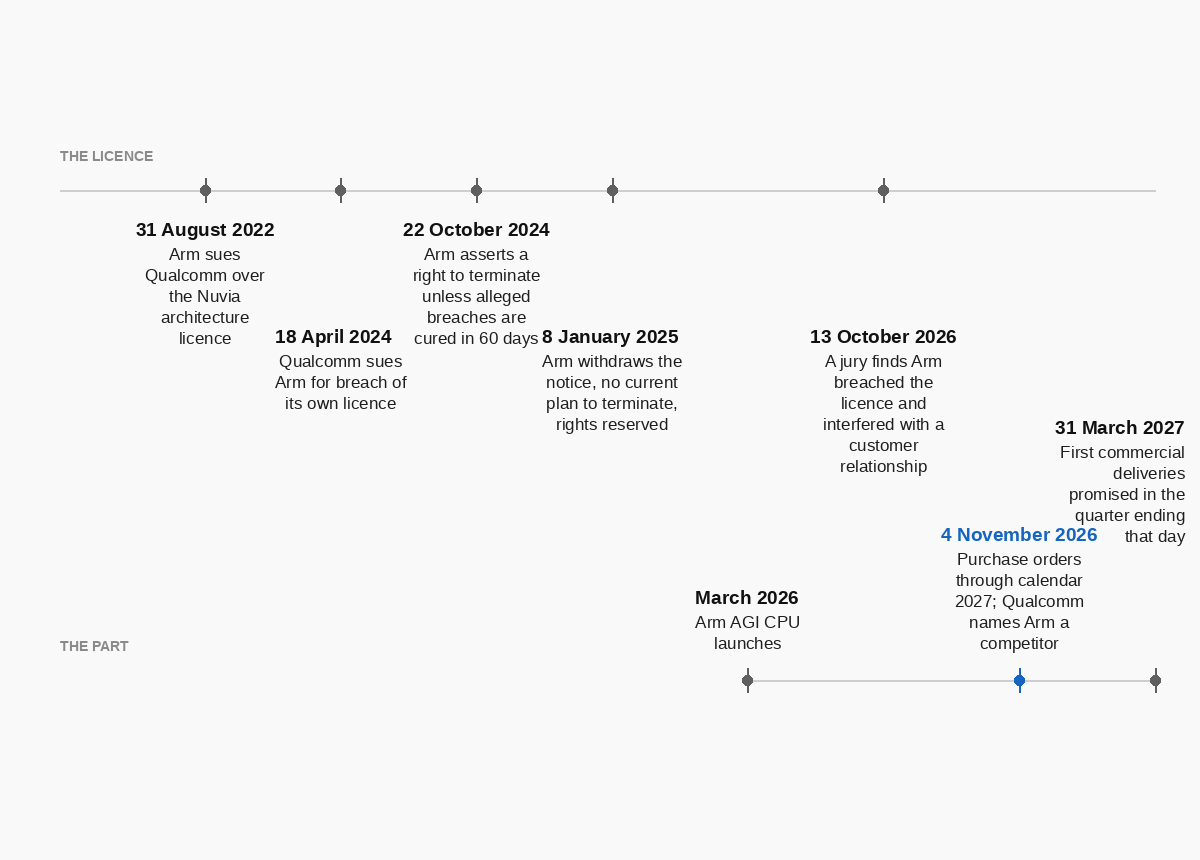
One signature produces all three decisions, and all three are taken by 31 March 2027, the quarter Arm targets its first commercial AGI CPU shipments: the CIO rewrites the standard to name suppliers, the General Counsel rewrites the indemnity to answer a notice rather than a termination, and the CFO re-forecasts the 2027 platform line. Left alone, the CIO brings a second-source request to the CFO as a premium against a quote that no longer compares like for like, and the General Counsel is asked to paper it after the standard is already written.
Three dated events settle it. The Delaware court has not yet decided the bench trial issues that follow the 13 October 2026 verdict, and that is where a finding of interference becomes something a contract can price. The Third Circuit heard Arm's appeal in the Nuvia case on 21 October 2026 and has not ruled, and that appeal decides whether an architecture licence survives the acquisition of its holder. Arm's first commercial AGI CPU deliveries are targeted for the quarter ending 31 March 2027, with OCI instances following in calendar 2027, and Arm guides $1.54 billion of revenue, plus or minus $50 million, for the quarter ending 31 December 2026, so the first reading on whether the silicon line is real arrives before the deliveries.
What reaches the board is one resolution on the 2027-28 server standard: no supplier is named in it without a warranty of a current architecture licence for the generation being bought, a 10 day notice covenant on any cure notice served on that supplier, and a second source funded at signature. It is taken by 31 March 2027, the quarter Arm targets its first commercial AGI CPU shipments and the last date the standard can change before the refresh is ordered. If no server maker or cloud discloses a licence-assurance condition in a filing before 30 June 2027, and Arm's own CPU ships into Oracle Cloud Infrastructure and no further, read this as a product launch inside an architecture rather than a change in who controls it.
Share this
Related