ReportArchitectureAnnika Sorensen11 min read
ReportArchitecture



A new model can reject a deprecated parameter, and a new API version can remove it for every model.
Two dates now sit inside the FY27 plan, and both were set by the supplier. claude-sonnet-4-5-20250929 is retired on 30 November 2026 on the 61 days of notice Anthropic gave on 30 September. GPT-4o, GPT-4o mini, GPT-4.1 and GPT-4.1 mini leave the OpenAI API on 14 January 2027 on 92 days of notice. Behind those two, Anthropic lists seventeen live Claude models and attaches a fixed retirement date to exactly one of them; the other sixteen carry a floor, written as not sooner than, apart from claude-mythos-preview, whose date is to be announced, and a floor is not a date a forecast can be built on.
The CIO owns the migration. The CFO owns the number, and the number moved twice: the Sonnet rate fell a third on the published page, and what arrives on the invoice is about 13%. The General Counsel owns a clause that mostly does not exist, because no vendor publishes a notice period as a contract term. The head of model risk owns the part nobody has budgeted: an eval suite calibrated at temperature zero against a pinned snapshot now measures a model that will not accept the setting.
Anthropic's price table lists Claude Sonnet 4.5 at $3 per million input tokens and $15 per million output tokens. Claude Sonnet 5.5 is listed at $2 and $10. That is 33.3% off both sides of the meter. The tokenizer takes part of it back. The release note that launched Claude Sonnet 5 on 30 June 2026 says the model uses a new tokenizer that produces approximately 30% more tokens for the same text, and adds that the exact increase depends on the content and workload shape. A corpus that billed one million tokens on 4.5 bills 1.3 million on 5.5. At $2 a million that is $2.60, against $3.00 before. Output runs the same way: $13.00 against $15.00. The bill falls 13.3%, roughly two fifths of the third the rate card shows, and a vendor handed a 30% token increase would have had to cut the per-token price by 23.1% to leave the customer where it started.
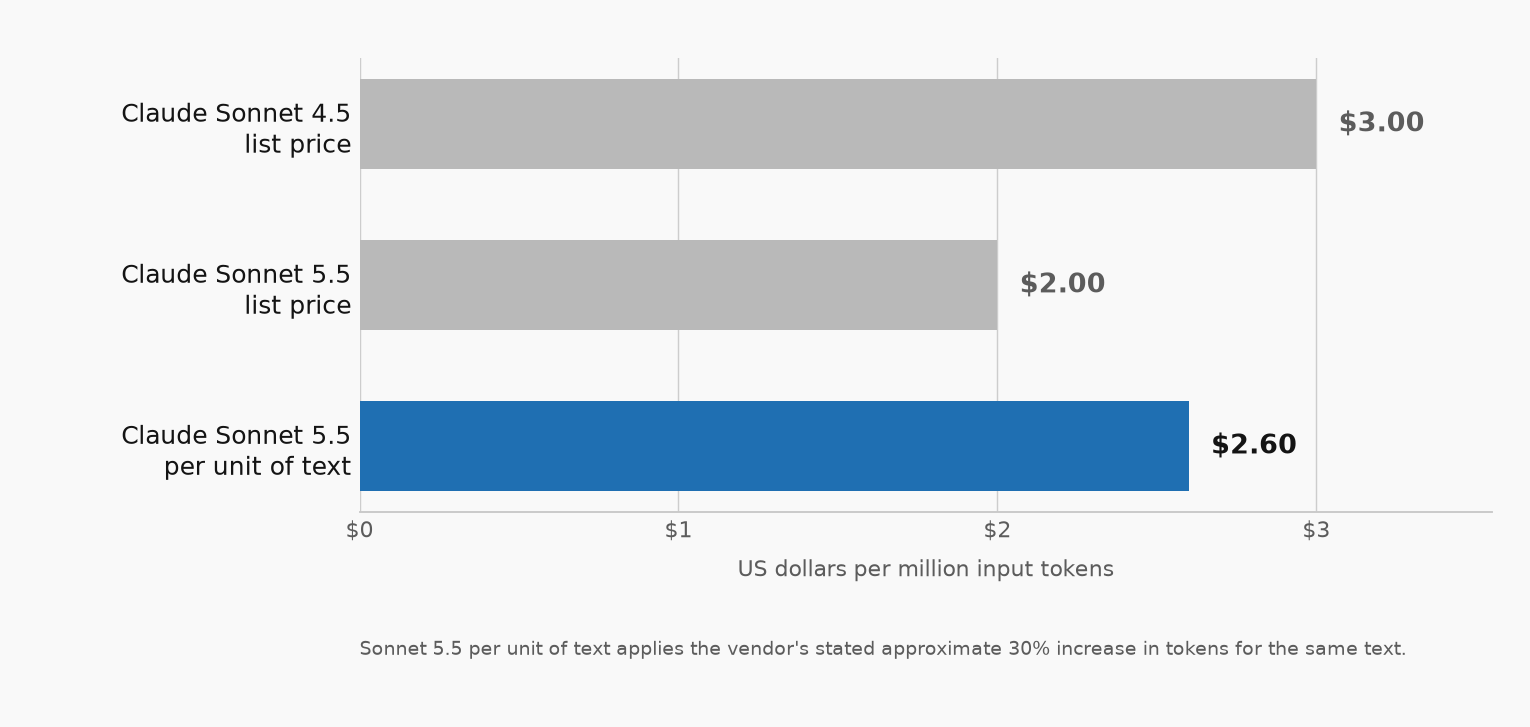
Two qualifications belong in the same breath. The 30% is the vendor's approximation and not a measurement of any one workload, and a corpus of structured records will tokenize differently from a corpus of prose. And the rate card did not have to fall at all: the same pricing page records that Claude Sonnet 5 launched on 30 June 2026 at $2 and $10 as introductory pricing, that the figure became the standard price on 10 August 2026, and that the previously scheduled increase to $3 and $15 on 1 September 2026 will not occur.
OpenAI's changelog entry of 3 September 2026 for GPT-6 Astra states that the model does not support custom temperature or top_p values or log probabilities. Anthropic's API version 2026-10-21, released on 21 October 2026, does the same at the API level: the parameter table on its deprecations page records temperature, top_p and top_k as removed in that version, where they return a 400 error. Forty eight days apart, both vendors withdrew the setting an enterprise uses to make a model's output repeatable. It is a 400 and not a warning, so a pipeline built at temperature zero stops rather than drifts.
The pin does not save it, and this is the part that will be discovered in production. On Claude 4.7 and later models, and on Claude Mythos Preview, the same page says earlier API versions return the error when the parameters are set to a non-default value. Pinning the API version therefore preserves the parameter on older models and does nothing on the newer ones. The model decides, not the version header, and the model is the vendor's.
| Vendor | Models | Announced or released | Retired | Interval | Published notice policy |
|---|---|---|---|---|---|
| Anthropic | claude-sonnet-4-5-20250929 | 30 September 2026 | 30 November 2026 | 61 days | At least 60 days for publicly released models, stated in the deprecations documentation rather than in a contract term |
| OpenAI | GPT-4o, GPT-4o mini, GPT-4.1, GPT-4.1 mini | 14 October 2026 | 14 January 2027 | 92 days | At least 6 months for generally available models, unless safety or compliance concerns require a faster timeline |
| OpenAI | GPT-5.3-Codex, GPT-5.1, GPT-5.4-Nano | 1 October 2026 | 1 April 2027 | 6 months, 182 days | At least 6 months for generally available models, at least 3 months for specialised variants |
| Google Cloud | gemini-2.5-pro | 17 June 2025, release date | 20 October 2026 | 16 months | At least 12 months after release, and not moved to an earlier date than what is listed |
Anthropic model deprecations page; OpenAI deprecations page; Google Cloud model versions page; all read 3 November 2026. Intervals are computed from the dates in each row by Mosaic Singularity analysis, November 2026.
OpenAI publishes the most specific notice policy of the three, and it is written as a policy rather than a term. The page states minimum notice of at least six months for generally available models, three months for specialised variants of them and as little as two weeks for preview models, and it qualifies the whole list twice: "Unless safety or compliance concerns require a faster timeline", and, where they do, "we will provide as much notice as reasonably possible." The batch announced on 1 October 2026 was given the six months the policy states, retiring 1 April 2027. The batch announced on 14 October 2026, four models that are neither previews nor specialised variants under the page's own definitions, was given 92 days, retiring 14 January 2027, and the entry records no reason and names no limb. That is the whole of the protection: a published minimum, an exception the vendor applies, and no statement of whether the exception is what produced 92 days. The one route past a shutdown date the page does describe is a commercial conversation, because it says only that "In some cases, developers may be able to provision dedicated capacity for continued access after a model's shutdown date." Google forecloses one direction in a single line, that retirement timelines may be extended but "won't be moved to an earlier date than what is listed", and gemini-2.5-pro ran from 17 June 2025 to 20 October 2026. Anthropic's floor is the shortest of the three and the narrowest: "at least 60 days' notice before model retirement for publicly released models", to customers with active deployments, stated in the deprecations documentation rather than in a contract term. The same page adds that partner platforms such as Amazon Bedrock and Claude on Google Cloud managed by Google set their own retirement schedules, so the same model can carry a different date by channel.
Take the two directions together and the CFO's problem is not the price. It is that the same line item can move by 13% or by 95% in one migration, and which happens depends on whether the workload can run on the model the vendor named. A summarisation job that survives the move to gpt-6-luna costs 96% less per input token. A job that does not survive costs a re-architecture, and 92 days is the whole of the notice in which to find out which one it is.
The re-validation is where the money goes, and no vendor page helps with it. An eval suite built at temperature zero on a pinned snapshot has to be rebuilt, because the parameter is refused on the current generation and the snapshot has a retirement date. In a regulated firm that is model risk evidence rather than a test run: the validation record names a version, and the version has an expiry. The enterprise that could evidence a controlled system now has to evidence it against a model it does not control, on a schedule it did not set, and it has to do so with the sampling parameters that made the original measurement reproducible removed from the interface.
The retirement date is a deadline for two of the four seats, not the finish line. The CFO and the CIO owe theirs on 30 November 2026, the day claude-sonnet-4-5-20250929 retires; the General Counsel owes on 14 January 2027 and the head of model risk on 31 January 2027.
By 30 November 2026 the board resolves the first question below against an artefact, not a presentation: the register of production models carrying a fixed retirement date, the seat accountable for each migration, and the date each migration is funded in the FY27 plan.
Share this
Related