ReportGovernanceStrategic Intelligence Division10 min read
ReportGovernance


| Layer | What the supplier covers | What removes the cover | Who carries the IP risk |
|---|---|---|---|
| Platform, its own model | 31 named Amazon services and models, §50.10 | Fine-tuning or modification that caused the infringement, §50.10.2(iv) | Amazon, uncapped, for the listed models only |
| Platform, a third-party model | Nothing under §50.10; third-party models are offered on Bedrock as Third-Party Content, §50.12.1 | The listed cover does not reach them at all | The buyer, unless the model vendor’s own terms reach the buyer separately |
| Model vendor, direct | The customer’s paid use of the services and the outputs of that use, K.1 | Modification, or combination with anything the vendor did not provide, K.3(a) and K.3(b) | The vendor, outside those exclusions, and the vendor controls the defence |
| Open weights | No warranty of title and none of non-infringement, §3 | Any use or distribution of the materials, §5(c) | The licensee, which indemnifies Meta, §5(c) |
AWS Service Terms §50.10, §50.10.2(iv), §50.12.1 and §50.16.1; Anthropic Commercial Terms of Service, effective 17 June 2025, K.1 and K.3; Llama 4 Community License Agreement, effective 5 April 2025, §3 and §5(c).
Two software companies put the gap in writing on consecutive days. Figma’s quarterly report on Form 10-Q filed 4 November 2026 states that “such indemnification may be inadequate or we may not be successful in adequately recovering our losses in connection with such claims”. Amplitude’s Form 10-Q filed 5 November 2026 says the company “may not be successful in adequately recovering our losses in connection with such claims under any such indemnification provisions”. Both sentences are about recovery rather than about cover: a company has bought AI, expects the provider’s indemnity to answer a claim, and tells investors the answer may not arrive. Figma then names the mechanism in one line, that recovery “may be limited by contractual liability caps, exclusions, or indemnification terms, or by the provider’s financial resources”. This reaches a buyer that has put a model into something customer-facing and has also tuned, combined or self-hosted it, and that has been treating one word in a deal summary, indemnity, as the whole of the protection.
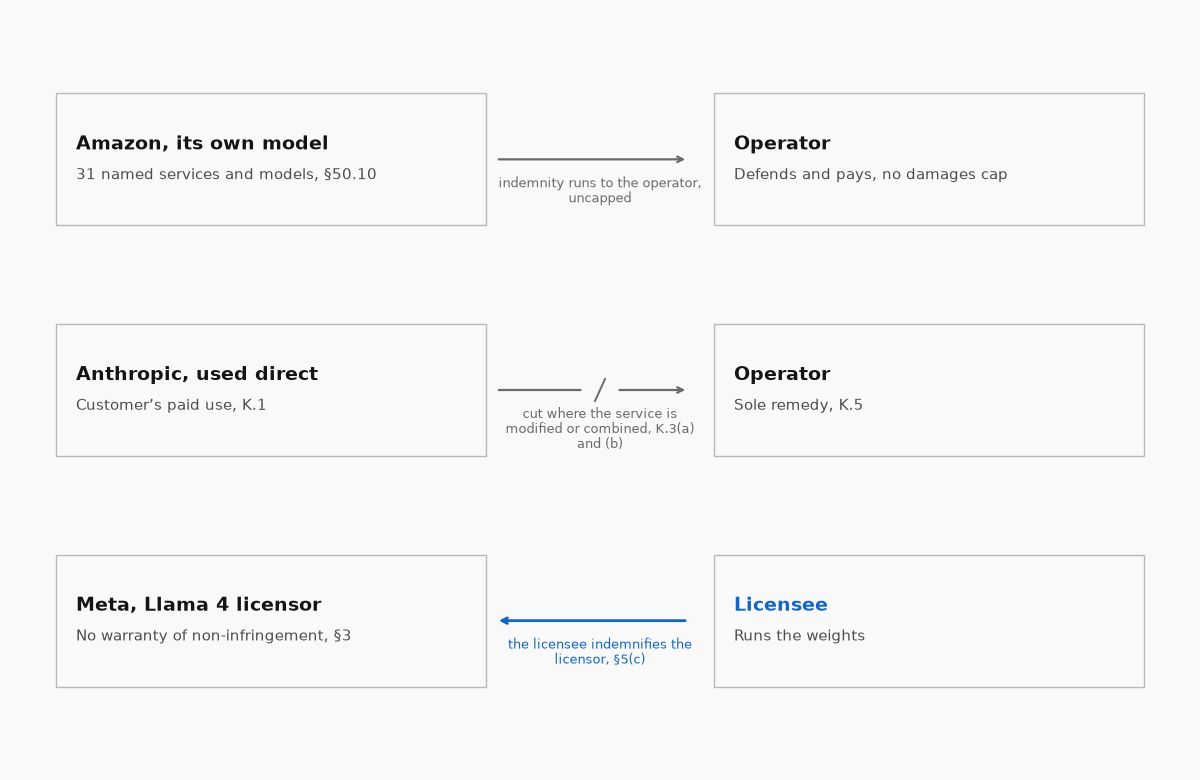
The Amazon Web Services Service Terms, last updated 5 November 2026, define the covered set as “generally available features of” thirty-one named items, running from Amazon Nova Micro and Amazon Nova Lite through Amazon Titan Text Express, AWS HealthScribe, Amazon Personalize, Amazon Connect Health and Amazon Lex to Kiro and AWS Quick. Every name on the list is Amazon’s own. Section 50.10.1 of those terms obliges Amazon to defend you against a third-party claim “alleging that the Generative AI Output generated by an Indemnified Generative AI Service infringes or misappropriates that third party’s intellectual property rights”, and the section states that this obligation “will not be subject to any damages cap under the Agreement”. An uncapped indemnity scoped to a closed list is worth the length of the list. Third-party models are dealt with one section later: “Third-party models are available to you on Amazon Bedrock as”, and the same section labels them Third-Party Content. Claude on AWS is dealt with in §50.16.1: “Your use of Claude Platform on AWS is subject to Anthropic’s Commercial Terms of Service, Data Processing Addendum, Usage Policy, and other agreements with Anthropic governing your use of their services.”
AWS Service Terms §50.10, counted from the definition itself; Google Cloud, Generative AI Indemnified Services, last modified 20 July 2026, with sixteen earlier versions listed back to 12 October 2023.
Google’s page states what the instrument is in its first line: “The following Services are covered by the Additional Google Indemnification Obligations in the Service Specific Terms.” Its foundation-model cover is narrower than Amazon’s in a way that matters at an operating level. The API is covered only when “used with generally available versions of these foundation models”, and the models named are Codey, Gemini, Imagen, PaLM and Veo. A preview model is not described by that sentence, and neither is a tuned derivative of one of the five. The page also carries sixteen earlier versions back to 12 October 2023, which is seventeen dated versions across 1,012 days, a mean interval of 63 days. A three-year commitment therefore spans roughly seventeen revisions of the document that decides what the cover attaches to, and the revision happens on the supplier’s calendar.
Amazon narrows its exclusion with a causation test. Section 50.10.2 removes the obligation where “you have fine-tuned, refined, customized, or otherwise modified an Indemnified Generative AI Service and the alleged infringement or misappropriation would not have occurred but for this fine-tuning, refinement, customization, or modification”. Both limbs have to hold, so a modification that did not cause the infringement leaves the cover standing. The Anthropic Commercial Terms of Service, effective 17 June 2025, are written without that test: K.3 states that the obligations “will not apply to the extent the Customer Claim arises from: (a) modifications made by Customer to the Services or Outputs; (b) the combination of the Services or Outputs with technology or content not provided by Anthropic”. A retrieval layer, a tool-calling wrapper or a tuned adapter is a combination with technology Anthropic did not provide, and K.3 asks nothing further. K.5 then makes the indemnity the sole remedy, and K.1 confines a Customer Claim to “Customer’s paid use of the Services”, which puts use that is not paid for outside the definition before any exclusion is reached.
The Llama 4 Community License Agreement, effective 5 April 2025, removes the warranty and reverses the indemnity in two sections. Section 3 disclaims all warranties “INCLUDING, WITHOUT LIMITATION, ANY WARRANTIES OF TITLE, NON-INFRINGEMENT, MERCHANTABILITY, OR FITNESS FOR A PARTICULAR PURPOSE”. Section 5(c) then states: “You will indemnify and hold harmless Meta from and against any claim by any third party arising out of or related to your use or distribution of the Llama Materials.” The same paragraph terminates the licence of any licensee that sues Meta alleging that the Llama Materials infringe intellectual property or other rights it owns or may license. An operator that self-hosts for control of the weights takes the IP risk a platform product would otherwise have carried, and takes it in the direction of the licensor rather than from it. That is the part of the sovereignty case no procurement paper carries.
The beneficiary is the platform that writes the list, because the list turns IP cover into a switching cost attached to model choice: the listed model becomes the defensible default at whatever premium it carries, and an unlisted one has to be argued for against a clause rather than against a price. The loser is the enterprise that fine-tuned, combined or self-hosted, which holds a capability with no IP cover behind it, and second in line is the software company that has built a licensed model into its own product, which holds an indemnity it receives and may not be able to collect: Figma describes the position when it says that where a claim arises as a result of third-party technology it has licensed for use in its platform, “we may be unable to recover from the appropriate third party any expenses or other liabilities that we incur”, and Amplitude when it says “we may not be successful in adequately recovering our losses in connection with such claims”. Neither filing quantifies the exposure, so the unit is the deployment rather than the contract: for each model in a customer-facing path the buyer either holds a clause that answers a claim or does not, and the count of deployments without one is the number that belongs in the FY27 plan.
The general counsel owns the clause and has until 31 March 2027 either to attach the supplier’s covered-model list to the agreement as a schedule or to write the uncovered deployments into the risk register as retained. The CTO owns the inventory that makes the clause answerable, because a schedule is only enforceable against a model the company can name. The CFO owns the number that inventory produces. None of the three can finish without the others, and the renewal document is the only place all three meet.
| Seat | What to do | By when | Why this one |
|---|---|---|---|
| General Counsel | Attach the covered-model list to the agreement as a schedule with a change-notice obligation, and move the §50.10.3 notice, defence-control and record-keeping conditions into the incident procedure | Before 31 March 2027 | Amazon’s cover is conditional on prompt written notice, Amazon controlling the defence, and retained records |
| CTO | List every model in a customer-facing path and mark each one: on a supplier’s list, a generally available version, unmodified, or none of those | Before 31 March 2027 | Google covers five foundation models used with their generally available versions, and nothing else |
| Chief Procurement Officer | Require the vendor’s written answer on whether a fine-tune of a listed model stays covered, and price the unlisted model on the assumption that it does not | Before 31 March 2027 | K.3(a) removes Anthropic’s clause for modification with no but-for test to argue |
| CFO | Carry the deployments without a clause as retained exposure in the FY27 plan rather than as a vendor credit | Before 31 March 2027 | Figma’s own filing says recovery may fail on caps, exclusions or the provider’s resources |
AWS Service Terms §50.10.2(iv) and §50.10.3; Anthropic Commercial Terms K.3(a) and K.5; Google Cloud, Generative AI Indemnified Services, 20 July 2026; Figma, Inc., Form 10-Q filed 4 November 2026.
What reaches the board by 31 March 2027 is one decision with two outcomes: the FY27 platform renewal goes forward with the supplier’s covered-model list attached as a schedule and a change-notice obligation, or it goes forward with every deployment that has no clause behind it carried in the FY27 plan and on the risk register as retained exposure. The chief executive brings one of those two, and the questions below are how the board tests which one it is being asked to approve.
Share this
Related