ReportSecurityStrategic Intelligence Division11 min read
ReportSecurity


eMudhra, Statement on Recent Certificate Security Incident, first published 20 October 2026 and updated 30 October 2026, quoting Mozilla's 20:06 and 22:59 UTC timings of 17 October 2026 and its own "about 18 months" and "within 14 hours of our confirming the issue"; Update 6 of 28 October 2026 for the 30,800 certificates. Mosaic Singularity analysis, November 2026: 20:06 to 22:59 UTC is 2 hours 53 minutes.
Its own Statement on Recent Certificate Security Incident, first published on 20 October 2026, sets out every assurance that had passed. The eight intermediates were created in a key generation ceremony on 30 April 2025, their keys were generated on FIPS 140-2 Level 3 certified hardware security modules, the hierarchy entered browser trust lists in mid-2025, and it has since passed two independent audit cycles. The published intermediates were the weak ones throughout, and an outside researcher found them on 17 October 2026. Five days later the board decided to withdraw from the global SSL/TLS certificate business, and gave as its reasons the cost and complexity of the line, the free certificates large entities already issue, and scrutiny it called out of proportion. This reaches you if your certificate estate is single-CA, or if the servers, build agents and container images behind it keep trust stores of their own, because that is the part of this neither the browser vendors nor the certificate authority can close for you.
Mozilla received the report at 20:06 UTC on 17 October 2026. "By 22:59 UTC the same day, the update had reached all Firefox users with standard configurations, without requiring them to update or restart Firefox." Chrome blocked the affected intermediates within hours as well, followed by Apple and Microsoft, on the sequence ICRA records and eMudhra reproduces. Distrust is a root program's decision, not the certificate authority's and not the buyer's, and four of them made it inside a working day.
The same speed is not available inside an estate. JetBrains told its TeamCity customers on 3 November 2026 that "Software with its own trust store, such as a Java runtime, keeps trusting the compromised certificates until that trust store is updated", and that its own health report for the affected roots covers server nodes only: "The health report does not check agents."
| Where the trust sits | Who closes it | What that takes |
|---|---|---|
| Mozilla's OneCRL, which Firefox reads | Mozilla | Nothing. Every standard configuration by 22:59 UTC on 17 October 2026, without a restart. |
| Chrome, Apple and Microsoft platforms | Those vendors | Install the vendor update. ICRA records Chrome and Firefox blocking within hours, followed by Apple and Microsoft. |
| Java runtime on a server node or a build agent | Platform team | A runtime build carrying the fix, for example Amazon Corretto 21.0.13.0.11 or later, then a restart of each node or agent. |
| Certificates uploaded into an application | Application owner | Delete or replace them. Updating the runtime does not remove uploaded certificates. |
| Container images and custom builds | Build team | Rebuild the image with an updated store and recreate the containers. |
| Operating system store, Git and MinGit, Python certifi, Node.js | Platform team | A separate update for each, from each vendor, on each image. |
Mozilla's timings as quoted by eMudhra, Statement on Recent Certificate Security Incident, Update 1, 20 October 2026; ICRA's sequence as reproduced in eMudhra's release of 23 October 2026; rows three to six are the stores JetBrains names in its TeamCity advisory of 3 November 2026, which states that "Updating Java does not remove uploaded certificates" and that "The health report does not check agents".
Count them as the unit of this problem: one trust store, one owner, one update. The question to carry into your own estate is how many of the places above you can name an owner for, because the certificate authority's remedy reaches none of them, and the revocation that began this arrived 14 hours after the supplier confirmed the defect.
The supplier's own account is the evidence, and it is worth reading at the level of the ceremony. "During the ceremony, a key wrap/unwrap step produced a second, weak set of keys alongside the original strong keys. The weak keys were the ones published to the browser root stores. The issue went undetected for about 18 months, through two independent audit cycles." The leadership note of 26 October 2026 is shorter: "A script error resulted in issuing CA's with weak keys."
The hardware was not the failure, and the supplier says so. "The keys were generated on FIPS 140-2 Level 3 certified Hardware Security Modules (HSMs)." And: "The problem was a flaw in one step of the ceremony procedure, not the absence of HSMs." There was no breach of its infrastructure and no customer data lost, in the supplier's account. The eight intermediates "had not issued publicly trusted end-entity certificates", seven were never used in production, and the one that was in production "had not issued a single certificate". What was lost was not data. It was about 18 months in which the published key was the weak one, and a certificate estate that then had to move inside a window four root programs set.
The question a certificate buyer can put to a supplier is therefore narrow and answerable: what can you show me about the key that signs my certificate? Not the audit opinion, which passed twice while the published keys were weak. The ceremony record, the wrap and unwrap procedure, the key that was actually published to the root stores, and the name of whoever checked it. A supplier that cannot produce those has sold an assurance about a process, not about the artefact your customers' browsers were trusting.
On 22 October 2026 eMudhra's board "decided to voluntarily withdraw from the global SSL/TLS certificate business". The chairman's reasons are in the release: rising data sovereignty and compliance requirements, complexity and cost, "some of the large entities issue the SSL/TLS free of cost", and "the level of social media amplification around this incident has brought scrutiny that is out of proportion to SSL/TLS's place in our business". ICRA retained the ratings the next day, 23 October 2026, "[ICRA]A (Stable)/[ICRA]A1 on Rs 35 crore of eMudhra Limited's unallocated limits", and recorded that "The global TLS business contributes only about 1 per cent of consolidated revenue." For a supplier that arithmetic makes leaving rational. For a buyer it means the party that sold the assurance is winding the line down on a timetable that ends with somebody else's migration.
That timetable is the part to watch, because it is the one deadline in the five documents that nobody has set. G1 issuance "is being used only to support this transition", and eMudhra "will stop issuing TLS certificates from G1 once the federation's transition is complete". No date appears anywhere, and the federation is not named.
The winner is Sectigo, and the offer went wider than the incident. On 22 October 2026 eMudhra said it was "making certificates issued by Sectigo available as an alternate option to all of our customers". By 26 October 2026 the terms were "at no additional cost, including to customers whose existing certificates are completely unaffected by the incident", which that release calls "a proactive CA redundancy measure, rather than a remediation requirement for customers in the region". A competitor's certificate, at zero, to the entire installed base, while the chairman explains that large entities already issue SSL/TLS free of cost: that is where the margin in this line had gone.
The durable gain is not Sectigo's book. It is the requirement the incident has made ordinary, and eMudhra wrote it down on 21 October 2026: "We are offering every Enterprise TLS customer certificates from an additional publicly trusted CA. If one hierarchy ever has a problem, customers can switch without interrupting their business." That sentence is now the benchmark for the next renewal, including with a different supplier: two independently operated authorities in the estate, switchable without interrupting service. The buyer who does not ask for it has accepted single-CA risk on terms nobody offered them.
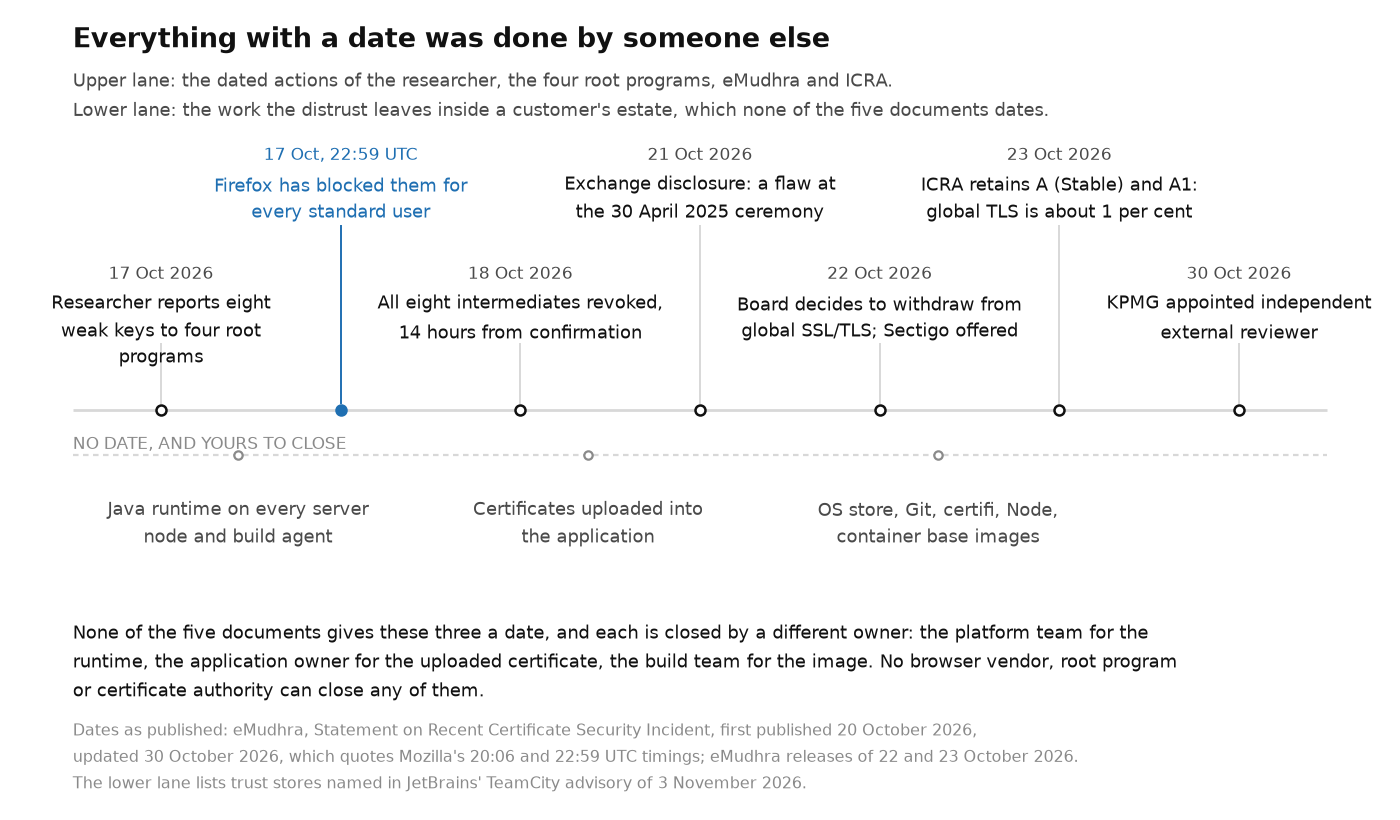
KPMG was appointed "independent external reviewer" on 30 October 2026, and the supplier has committed to "a full root-cause analysis through the CCADB process", which "will explain what went wrong, why our controls failed to detect it, and the changes we are making as a result". It has not been published, and eMudhra states plainly that "We have not yet confirmed the exact root cause." Until it appears, no buyer can test the ceremony against an audit standard, which is why the contractual right to the ceremony record is worth more than the promise of a report. One nearby fact is a different event: the removal of eMudhra's Root CA's C1 and C3 with Mozilla "was a voluntary and planned activity and does not pertain to this security incident".

Share this
Related